Search This Blog

Showing posts with label marine debris. Show all posts

Tuesday, January 31, 2012

Albatross News -- STAL on Tern!!!

We're definitely in albatross season now!  Chicks are everywhere, and growing like mad.  And this morning, while I was writing this blog, Morgan Gilmour found a short-tailed albatross on Tern!!!!  These endangered birds have only been seen in FFS once in February 1994, and Februrary 2002 -- so this is a special sighting!
Short tailed albatross on Tern today!!  Photo by Dakshina Marlier (above), and Sarah Youngren (below). 
(We'll have better pictures later, but we dont want to disturb him/her.)

Along with our previous O'ahu moli visitor, and a current nesting moli on Tern, banded on Kaua’i in 2008 -- French Frigate Shoals is turning into quite the metropolitan place to nest!

Morgan Gilmour is working on a project tagging albatrosses at Tern Island, for the Tagging of Pacific Pelagics program (University of California, Santa Cruz).  She is using both satellite and GPS tracking to monitor where the adults find food during incubation and chick-rearing.  This will tell us something both interesting, and useful if we need to protect an area or resource, or if we are impacting these resources.
Below is a GPS track of a female ka’upu (black-footed albatross) that was originally banded as a nesting adult in 1998.  During her month-long foraging trip, she traveled very near to Vancouver Island and then Haida Gwaii (formerly Queen Charlotte Island) in British Columbia.  Unlike the mōlī (Laysan albatross), that tend to forage more in the central Northern Pacific, ke ka’upu seem to prefer foraging up the West Coast of North America.  The amount of plastic floating around in these areas also shows up in their chicks – a lot more in the mōlī, who forage closer to the “garbage dump.”
Satellite track of a ka'upu (photo below) heading up the West Coast, looking for food before returning to its nest. 
It seems that this bird encountered stormy weather near Alaska, because when she arrived back on Tern, the GPS tag was water-logged.  Only the first half of the trip data was recorded, as you can see on the map.  What a long way to go just for dinner!!!   After she returns to the nest, her mate will take off on a similar foraging trip.  This long trip appears to have been successful because the egg hatched two weeks after the bird returned to Tern Island, and the chick is doing well.
This is the very bird who was tracked heading up the West Coast (above), with its chick.  Photo by Morgan Gilmour.
In addition to the satellite and GPS tracking, Scott Shaffer (UCSC) and David Hyrenbach (HPU) have agreed to let us combine part of our monitoring program efforts with part of theirs – so we can study where not only where the parent’s go, but how that affects chick growth.  We may also be able to match up the plastic ingested by chicks with where their parents’ foraged.   This kind of partner cooperation makes the whole much larger than the sum of its parts.  Thanks to David and Scott for agreeing to be so cooperative, and thanks to Morgan and Abram for getting the work done!  (It takes a team to do great science!)

Above:  Measuring the tarsus.  Below:  Drawing blood samples.  Abram Fleishman is holding the ka’upu.  Morgan Gilmour is taking measurements and samples.  This information will tell us a lot about the health of the bird.

And some other assorted news and photos:
Dan and Sarah saw a ka'upu with a 'streamer', and tracked it down.  The bird had a hand-braided nylon line wrapped twice around its uper leg, knotted twice, and with a bolen-loop on the other end.  It looked awfully like someone had tied this bird up, and it escaped.  Luckily the crew removed it before much damage was done -- the bird is scarred, but won't lose its leg.  Nice job, crew!


Female turtle on South Beach.  We see mostly males and juveniles in the winter, but there's always exceptions.


Tern Island 'new' runway from the East end.  We're glad to see birds nesting in this area.

Paula Hartzell and Dan Rapp releasing a small honu out of the double seawall.  Turtles get stuck behind the seawall after they washed over by high waves, then can't get back out.  This one was particularly tricky because it was swimming around in hip-deep water.  We waited for low tide so the waves wouldn't bash us, and so the turtle had time to calm down and go to sleep, then Sarah herded it to us.  We had to hand-pass the turtle to a wide enough opening, because the bottom of the wall is lined with broken rusty barrels facing up -- like tires on a football field, only rusty and jagged.  :-)  Everyone was careful, and the turtle was released healthy and unharmed.

Saturday, January 21, 2012

Holy Mōlī -- First Laysan albatross chick of the year!

First mōlī chick of the year!!!!  We'll call him/her Ka Hiapo, First Born.  Ka Hiapo is in Nest #48 of our chick growth study looking at the effects of plastic marine debris ingestion on chick growth, so we'll be able to follow this chick through the season with you.
Ka Hiapo:  The first Laysan albatross chick of the year!  (Photos by Sarah Youngren, 21Jan2012)

Monday, November 7, 2011

Lānaʻi High School Students "Sail" to Tern Island


Tern Island is probably about 600 miles away from Lānaʻi High School, which is close to the southeastern end of the Hawaiian Islands archipelago.  On Tuesday, October 18th the two locations seemed a little closer to each other.

On that day 21 high school juniors & seniors and their teacher made a "virtual field trip" to Tern Island, with Barb Mayer (USFWS volunteer) and Wes Byers (NOAA's Outreach Specialist for the Papahānaumokuākea Marine National Monument).

The virtual field trip to far-away Tern was made possible through a Powerpoint presentation, utilizing photos and this real-life video "The Searcher Departs from Honolulu":


After "setting sail" on the Searcher, the students imagined voyaging for 3 days to reach Tern Island where they were to start work as wildlife volunteers.  Therefore, at the conclusion of the Powerpoint, students were put to work in the classroom!  They were divided into small groups and rotated through several activities utilizing artifacts from Tern.

For example, here's an activity featuring actual marine animal eggs.  (They were infertile; they didn't hatch.  Therefore, it's possible for the US Fish and Wildlife Service to use them for education.  The eggs have been filled with plaster of paris, to strengthen them against accidental breakage.)


Most of the eggs are labeled with their birds' identifying, 4-letter code; two are not...or three, since you can't see the whole code for the egg on the right.  

Egg Challenge:  Of those three, which one belongs to the Laysan Albatross, Mōlī?  Which is the store-bought chicken egg?  ...and which one belongs to the Hawaiian Green Sea Turtle, Honu?  (Hint: reptile eggs don't have [much] calcium in them).  Honor system: don't peek until you're ready, but the answers are at the end of this post.


THAT can't be a Laysan Albatross, a Mōlī?!  Your're right; it's a stuffed toy.  Imagine how much bigger the REAL albatross parents are who laid this egg?


JMacaulay took this picture of a pair of adult Mōlī.

 Here's an activity about the Great Frigatebird's wingspan-->

Challenge: Place the Great Frigatebird (GRFR; ʻIwa) skeleton and both sets of wing bones in the proper places to represent a living bird's actual wingspan!

The students have put the GRFR skeleton in the middle of the 7' long fabric strip.  Now, can they correctly arrange the wing bones?

YES THEY CAN!  The answer sheet, which was hidden under a paper taped to the classroom's front board, confirmed their effort.  Wow, that ʻiwa has a chicken-size body and a hang-glider wingspan!
Back at the end of May "A Busy Time at Kānemilohaʻi" was posted.  Mark Sullivan's photo shows a particularly disturbing example of a Honu with marine debris, a porthole, around its neck:
Here's the porthole again.  Now it's being used to help students make the mind and heart connection to what marine debris actually does to life in the ocean. 

How does it feel to be caught in marine debris? Well, how does it feel to have this rubber band around your hand?!

The class period ended with everyone feeling a little closer to Tern Island Field Station and the Papahānaumokuākea Marine National Monument.  Barb and Wes look forward to "bringing the place to the people" in other classrooms around the state of Hawaiʻi!
- - - - - - - - - - - - - - - - - - - - - - - - - - - - - - - - - - - - - - - - - - - - - - - - - - - - - - - - - - - - - - - - - - - - - - - - - - - - - -
Egg Challenge Answers:
  • Laysan Albatross -- the BIG one on the right
  • Chicken -- in the top-right corner of the egg carton
  • Hawaiian Green Sea Turtle -- bottom-left in the carton

Monday, September 12, 2011

Deadly debris


This week we all got a good reminder that no piece of debris is too small to kill or injure wildlife. First we found this Sooty Tern fledgling stumbling around the colonies one evening. Because the poor creature was unable to fly, we captured it easily by hand and it became quickly evident why it was hobbling around. Its left leg was completely non-functional because a small section of monofilament fishing line had become tightly wrapped around the upper part of it. It had been there for quite some time because tissue had actually grown over the line.

Though this bird was still quite lively and, true to Sooty form, still attempted to bite and jab its handler, you can see from the condition of this bird's feathers that its chances of surviving this are not good. With feathers this far gone and its first molt not due for quite some time, our poor, (de)-feathered friend will not be able to leave the island and forage on its own. This is what will ultimately kill the bird. And while we cannot say for sure that the leg injury caused the feather degradation, its easy to imagine how weeks of hobbling around a seabird colony dragging wings through dirt and guano led to the present condition.

Anybody care to guess how long the offending piece of fishing line was?  Make an estimate, then check the answer at the bottom of this post!* 

These poor little Honu were recently found on the island as well. Since they turned up aways inland, the likely scenario is that they hatched out on the beach and somewhere between the ocean and middle of the island got tangled in this section of net. This particular piece of netting measured only 17" long and 3" wide. Typical commercial fishing gillnets like this can be up to several miles long. If a section this small can kill two turtle hatchlings imagine the damage that a mile of this stuff could do. It's an ugly thought.

We make every effort we can to remove the trash that washes ashore or gets blown inland, but even though Tern is a small island, there's still a lot of ground to cover by three people. We also have to carefully weigh the impact of our increased presence in active bird colonies and monk seal habitat with the benefit gained from removing debris immediately. There are no easy answers and we're still figuring out what our best approach should be. One thing is for absolute certain: it's important that the US Fish and Wildlife Service maintains its year-round presence out on Tern Island. If there were no staff and volunteers out here to collect debris and watch out for the turtles, seals, and seabirds that call this place home, there would be far more deadly entanglement incidents like this.

Shameless subject change! On a completely unrelated, but far brighter note, check out this Red-tailed Tropicbird chick. Born and raised right under our front porch, we get to enjoy watching her grow every day! Their eyes aren't actually quite that big, but they have a thick, black eye ring. So when a tropicbird chick looks at you straight on, their eyes look exaggeratedly large, cartoonish, and ridiculously adorable. Really, is it possible to not smile when you see this face???


(*Answer: 13 inches, which is an exponentially tiny fraction of the amount of derelict fishing gear and other debris that's out there in this bird's ocean habitat.)

Thursday, August 11, 2011

Hatchlings and Christmas Chicks

The honu are hatching now!  Every morning we walk along the runway, to find Hawaiian green sea turtle hatchlings that have lost their way during the night.
Honu hatchling.  Photo by Mark Sullivan
Because Tern Island is basically a man-made island with a lot of vegetation, structures, and other things that turtles wouldn't normally encounter on a sandy island -- and that they don't run into on any of the other islands in the atoll -- we have to make sure those that get waylaid along the way have a chance to get back out at sea.  Right now we check every morning, and release those hatchlings back into the sea.  Only about one in a thousand will make it all the way to being an adult turtle, but we figure if we save 1,000 hatchlings, that's kind of like saving one adult turtle.

This fall, after most of the seabirds have left, the crew will be moving a 12" PVC pipe to the inland side of the beach.  The pipe acts as a fence for the hatchlings, so should help more of lost ones find their way back to the sea, rather than get lost in Tern's vegetation.  This should further help the honu towards recovery.
Honu hatchling ponders the great moana.  Photo by Mark "Sissy" Sullivan.
The Christmas Shearwater (Puffinus nativitatis) chicks are also growing!  Most of them have some feathers now.  They are funny looking chicks, with a big fat body and little tiny head.  The adults are all dark brown to black, with a tube-nose for getting rid of salt.  They're about as big as both of your hands cupped together.  They arrive at Tern in February, and lay their eggs in March.  Its difficult to get good photos of them because they roost and nest in very dark areas under leafy bushes, and leave the island soon after it gets light.  They are very skittish, and will fly away if you come near them.
Christmas in a bush.  Photo from FWS file.
Christmases breed on islands throughout the central and south Pacific, although we don't know very much about how many there are or how they are doing as a species.  Christmases need good shade for roosting and nesting (on Tern, they sleep and nest only under healthy leafy bushes), and have no defense against rats, cats or other predators.   Christmases also breed on some of the small offshore islands in the Main Hawaiian Islands - so we have to be sure to keep those areas rat-free!

Mostly we see Christmas Shearwaters in the early morning, when they come out from under shrubs to bask in the morning light.  Although Christmases are never very numerous in one location, they are social in the morning, and usually sit in couples, 3s or 4s together, preening in the morning light.  After they warm up, they take off for a day of fishing before returning in the evening.
Merry Christmas!  Christmas Shearwaters are very affectionate with each other, and usually spend the early morning hours basking in the sun and preening each other.  Photo from FWS files.
Christmases are one of my favorite birds because they are so gentle with each other, and quiet when you catch them.  Although they kind of howl at night like Wedge-tailed Shearwaters, they only howl once or twice, and then quiet down -- They don't go on and on for hours, like Wedgies do.  When you catch a Christmas (as for banding), they peep rather pitifully, but don't try to peck your eyes out or bite you, as many birds do.
Seal pup REALLY close up....  Photo by Mark Sullivan.
Traditional Hawaiian cultural practitioner Leighton Tseu has been working with the seal crew these last two weeks.  Uncle has shared lots of stories with us, and reminded us why we are out here.  We will be in his debt for a long, long time.  Thank you, Uncle Leighton!!!  We have very much enjoyed having you here.  The seal crew has taken down their camp, and are getting ready to leave the atoll sometime next week.
Gratuitously cute seal pup photo, by Guess Who.  (yes, Mark Sullivan)
Swan Lake with Net.  Ben Cook and Mark Sullivan provide interpretive marine debris dance.
I will be leaving Tern Island this week (very sadly for me).  The good news is that the new Assistant Manager, Meg Duhr Schultz, will be taking over.  She will supply you with lots of good stories and news about the birds, seals, and turtles until my return to Tern in December.   Meg, Erin and Scott will continue here until that time -- Be safe, Meg, Erin, and Scott, and great adventures!

Paula before departure....

After Departure.... The vessel Searcher, taking Paula away.... and Life in the Atoll continues.

Sunday, May 29, 2011

A Busy Time at Kānemilohaʻi

Shew, the past couple weeks have been busy!!!

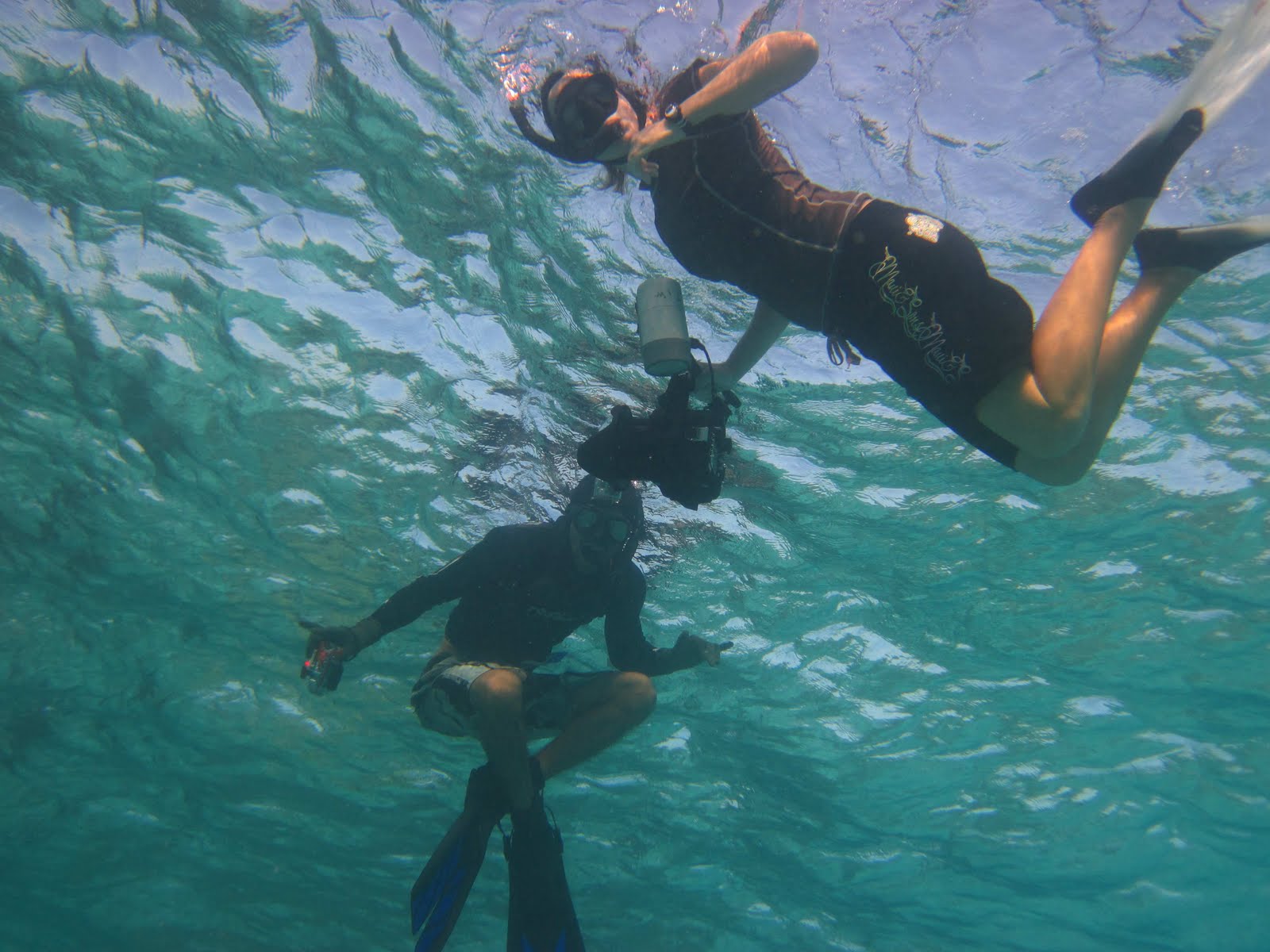
CORAL:  FWS Volunteer Lindsey Kramer prodded us all out in the water at the crack of dawn, boating over to Shark Island (a couple miles from Tern Island) for early morning snorkels.  She wanted to be the first person to witness cauliflower coral spawning in the Northwestern Hawaiian Islands.  And guess what?  It took a snorkeling a couple mornings in the frigid waters of April, and then a couple mornings in the warmer waters of May -- but she did it!!!  We were able to be the very first witnesses of cauliflower coral spawning on May 18th, with more spawning occurring on May 19th.  Way to go, Lindsey!!!


Photos by Paula L. Hartzell
SEALS:  We've had some gains and losses in the ʻilio o ke kai world...  Some new pups, and some pups are gone. One nice event occurred when one of the seal crew, Ben Cook, was camping out on Gin Island last week.  (The seal crew guys take turns staying out on the islands to watch out for the pups.)  A first time seal mom give birth – and then as the mom and pup failed to bond.  The pup wandered off looking for the mom, who was fairly unresponsive.  The pup then got caught and battered in the surf.  Ben was able to rescue the pop, and reunite the pair for the first nursing, which is the critical bonding period for these seals.  The new mom accepted the pup, and it looks like they’re doing well. The pup likely would have died without intervention, so we’re really glad Ben was out there.  

A new first-time mom (above) had problems bonding with her pup.  The pup got 'lost', when NMFS staff Ben Cook intervened, reuniting the pair.  The new mom accepted the pup, and it looks like they're doing well (below).  The pup would likely have died without the intervention, so we're really glad Ben was out there.   

Pups at Kānemilohaʻi face enormous challenges to make it through the first two years.  Insufficient forage for the moms mean less milk and shorter time to weaning for the pups.  The seal pups here are smaller as a consequence, even at birth: the biggest seal pup born here weighs less than the smallest pup born in the Main Hawaiian Islands -- Can you even imagine?!  They're also subject to high rates of shark predation over the past decade or so -- It may be that the sharks are also facing changes in forage, or perhaps they are attracted by the growing turtle population.  For whatever reason, we've already lost 4 of 10 pups so far, and its only the first month of the birthing season.  The seal team literally has to fight for the species one pup at a time!

OUTREACH:  We have to send out a special thanks to our new Education and Outreach Coordinator, Barbara Mayer, who has been working on curriculum for teachers to use this Fall.  An established curriculum and lesson plans will help teachers -- who are already overworked -- have an easier time working information on the Northwestern Hawaiian Islands and Kānemilohaʻi into their classrooms.  That should be great fun for the kids!  Barbara is also working with ʻIolani School for a Marine Debris class this summer -- so those of us on Tern are also busy collecting some marine debris, empty bird eggs, and the like to send back for the class.   She's also the one responsible for making the blog more organized and functional.  Mahalo nui e Barb!
This turtle had a ring of plastic -- waste from a boat -- caught around its neck.  The seal crew were able to catch the turtle, remove the ring, and release the turtle unharmed.  We saved the ring, which will be sent back to Honolulu on the next ship, for use in education and outreach.  Photo by Mark Sullivan.
TURTLES:  We counted 412 basking turtles on East Island this week!!!   This is fantastic -- and pretty amazing, considering the whole island is about 200 meters (650 feet) long!  

Honu on East Island.  We counted a remarkable 412 basking turtles at one time on East Island on Thursday this week.  Photo by Paula L. Hartzell.
Over 90% of the honu reproductive effort occurring at French Frigate Shoals.  The health of any species is dependent by many factors, and good management requires multi-faceted action.  The honu have benefited from very effective management in reducing fisheries-related mortality, some great luck (for the turtles anyway) in the increase in invasive algae species in Hawaiʻi, strong public support and wide emergency response in the Main Hawaiian Islands, along with the benefit of a totally protected nesting ground in the Monument – this threatened species’ population has been steadily increasing since 1973.  

BIRDS:  
We completed our first estimate of the ʻewaʻewa (sooty terns) on Tern Island.  There are about 133,000 adults and 32,500 eggs on island now -- That is one big bunch of ankle biters.

ʻEwaʻewa (sooty tern).   Now multiply this by 133,000 on an island a half mile long by a quarter mile wide.  Now imagine each and every one pecking your head and ankles.  :-)  Photo by Paula L. Hartzell.

How much effort do we spend monitoring birds on Tern Island?  We closely monitor about 1,500 individual nests each week!  That's in addition to all of the island-wide surveys, banding, entrapment walks, and special projects.

The last Tristram’s storm petrel fledged from artificial nest boxes this week!  FWS Volunteer Sarah Youngren has documented a strong relationship in patterns in weight gain and loss immediately prior to fledging, allowing us to accurately identify when a chick is ready to fledge.  We have made enormous strides in development of consistent, replicable, quantitative method for monitoring TRSP; we have vastly reduced the number of human-crushed burrows; and look forward to development of adult population monitoring next year, thanks to Sarah’s hard work over then last two years – and on into next year.  Good work, Sarah!


BUILDING NEWS:  FWS Volunteer has constructed a new shade-house on the back-porch, and is adding a roof to our front porch.  The shade-house will be used to grow native plants, which is sorely needed to give a boost to the shrubs on Tern Island.  Birds need the shrubs for nesting habitat, shade, and to consolidate soil around burrows.  Thanks, Curt, for getting all this built!


TEAM TERN:
While the bosses were away on the outer islands, the crew found a large rope mass floating in the water near the southeast end of Tern.  It took everyone working together to get it out.  (Apparently they all missed the memo that youʻre supposed to slack when the bosses are gone.)  From left to right:  Brendan Hurley (NMFS), James Macaulay (FWS), Kristina Dickson (FWS), Shawn Sullivan (NMFS), and Ben Cook (NMFS).  Photo by Sarah Youngren (FWS).
GRATUITOUS PRETTY (OR SILLY) PHOTOS
ʻĀ (red-footed booby) chick and its parent squash in for room on the nest.  Photo by Sarah Youngren.

Photo by Paula L. Hartzell.
Laughing kaʻupu.  (Black-footed albatross.)  The chicks have their  adult feathers on their bodies now, and getting some pretty funny hairstyles up top.  
Brown booby contemplates a fine day off of East Island.  Photo by Mark Sullivan.
Lindsey Kramer (top) and Mark Sullivan (bottom) waiting for coral to spawn.  
Sometimes you just have to step on your family..... An adult masked booby protects its chick.  Some might say masked boobies are a little overprotective -- A snowsuit in the tropics?!  Photo by Paula L. Hartzell.
THANKS to all of our readers, to the staff in Honolulu, and to our family and friends who support us.  We are very proud to be able to watch and protect these special resources, that belong to each and every one of us.

Popular Posts