Get ready for a sad picture, from the Hawaiian Monk Seal Research Program's Facebook Page --
The tale of French Frigate Shoals continues. In 1984, in response to decreasing condition of young seals, small numbers of weaned, female pups were captured at FFS and transported to Oʻahu for captive care to increase their size and improve their condition and likelihood of survival. They were then reintroduced into the wild at Kure Atoll (in the NWHI). This photo shows an example of a young seal who is struggling to get enough food.
Tern Island is located within French Frigate Shoals, part of the Hawaiian Islands National Wildlife Refuge, Papahānaumokuākea Marine National Monument, Hawaiʻi. French Frigate Shoals is home to many thousands of birds (albatross, boobies, terns, and more), Hawaiian monk seals, Hawaiian green sea turtles, and a few humans. Join us for adventures on a remote island.
Search This Blog
Showing posts with label Hawaiian Monk Seal. Show all posts
Wednesday, March 7, 2012
Tuesday, March 6, 2012
#3 - Hawaiian Monk Seal Research Program at French Frigate Shoals
![]() |
| photo credit P. Leary |
Today's topic from the Hawaiian Monk Seal Research Program's Facebook Page: The island that disappeared.
One of the factors contributing to the decline of the French Frigate Shoals seal population is the loss of important breeding habitat. Over the course of about 20 years, the low-lying, well-vegetated Whale-Skate Island disappeared. It was an important breeding site for monk seals, turtles, and numerous birds.
It isn't certain what caused the disappearance, probably a combination of sea level rise, currents and storms. The loss of Whale-Skate may be a sign of things to come based on climate predictions. This picture shows the submerged sand and reef of what was once an important monk seal pupping site.
Monday, March 5, 2012
#2 - Hawaiian Monk Seal Research Program at French Frigate Shoals
![]() |
| from the Hawaiian Monk Seal Research Program's Facebook Page |
Friday, March 2, 2012
#1 - Hawaiian Monk Seal Research Program at French Frigate Shoals
If you're a Facebook-er, you really should "like" the Hawaiian Monk Seal Research Program's Facebook Page. In the last few days they have been posting interesting information about Hawaiian Monk Seals on our atoll. Here's the most recent post, from today (Fri., March 2, 2012)--
"It's the first Friday of the month and we are going to focus on a scientist that has done a lot of work at French Frigate Shoals, Dr. Frank Parrish. Dr. Parrish's research focus has been on the feeding behavior and habitat use of monk seals, mostly at FFS.
But he is also interested in the ecological interactions between monk seals and other predators. Here is a link to a presentation that Dr. P gave several years ago, using Crittercam to look at competition between monk seals and other apex predators. It's a little long, but fascinating; presentation starts at about 2 minutes in.
The gist of it is that in much of the footage Dr. P observed fish and sharks escorting monk seals while they foraged. The predators exploited the seals’ superior ability to flush hidden prey from bottom cover by the probing, digging, and flipping of rocks. In many instances, the seal and predators competed for the same prey item. This was the first record of intense direct competition between monk seals and their competitors and revealed a potential major factor in poor juvenile survival."
Wednesday, December 14, 2011
A new season
It's the start of a new season, biologically and personnel-wise.
The ka'upu (black-footed albatross) have all arrived for the most part, but the mōlī (Laysan albatross) are still trickling in. Looks like a gang-buster year for the ka'upu this year! We'll have better numbers for you on that soon, as we've started the next adult albatross sweep -- That's where we go through the colony and read every band on every adult albatross across the island. We'll do this four times over the next month, as part of a mark-recapture study tracking the albatross' breeding populations across the northwestern Hawaiian islands. The staff at Midway Atoll and Laysan Islands follow the same procedure, so we can compare the results, and get a number for most of this species' populations.
We have a new double-egged ka'upu nest this week! Albatross usually have only one egg, but this bird is a super overachiever.
Sarah Youngren, Dan Rapp, and Abram Fleishman continue work on getting the bird acoustic monitoring system set up. They've been troubleshooting the electronics, have built frames to mount the solar battery charging panels and microphone, as well as to keep birds from pooping on these. The tricky part is to get everything to work without messing up the other electronic monitoring devices, like George Balazs's turtle cam -- but persistence pays off, and they're moving forward. Later on, we'll compare the results from the acoustic monitoring of Tristram's storm petrels with Sarah's burrow monitoring results, to calibrate the methods to estimate number of breeding adults.
Weeding, weeding, weeding! The invasive goosefoot and cheeseweed has begun to sprout up all over the island, but has not yet seeded, so we are starting to spend a significant amount of time pulling these buggers before they go to seed. Both goosefoot and cheeseweed grow into tall, dense monocultures, creating a barrier to wind and movement, and pose a serious threat to albatross chicks later in the winter and spring, when chicks bake in the heat inside these stands.
| The winter crew, satellite technicians, special volunteers and the crew of the Kahana leaving Tern. |
| The remaining crew.... Dakshina Marlier, Morgan Gilmour, Dan Rapp, Sarah Youngren, and Abram Fleishman. (Photo by Paula L. Hartzell) |
| Konrad Schaad helps with an albatross count on Trig Island. The ka'upu (blackfooted albatross) have arrived en force; the mōlī (Laysan albatross) are still arriving. Photo by Paula L. Hartzell. |
We have a new double-egged ka'upu nest this week! Albatross usually have only one egg, but this bird is a super overachiever.
Sarah Youngren, Dan Rapp, and Abram Fleishman continue work on getting the bird acoustic monitoring system set up. They've been troubleshooting the electronics, have built frames to mount the solar battery charging panels and microphone, as well as to keep birds from pooping on these. The tricky part is to get everything to work without messing up the other electronic monitoring devices, like George Balazs's turtle cam -- but persistence pays off, and they're moving forward. Later on, we'll compare the results from the acoustic monitoring of Tristram's storm petrels with Sarah's burrow monitoring results, to calibrate the methods to estimate number of breeding adults.
![]() |
| Dan Rapp working on setting up acoustics equipment. Photo by Sarah Youngren. |
| Okay, these people are seriously just too excited about bird monitoring. |
| Juvenile noio (black noddy). Photo by Meg Duhr Schultz. |
| East Beach at Tern Island. The sand has shifted way to the north. The beach shifts with seasons and storms, but also provides the best winds for gliding seabirds. (Photo by Paula L. Hartzell) |
Labels:
acoustic bird monitoring,
Albatross-Black-footed,
Albatross-Laysan,
habitat restoration,
Hawaiian Monk Seal,
Ka'upu,
Kahana,
Noddy-Black,
Tern-White,
Turtle-Hawaiian Green Sea,
volunteer life
Thursday, December 8, 2011
The Trip In
The new Tern crew loaded up -- along with SeeMore satellite technicians Konrad Schaad and Ralph Blancato, and Tern special volunteers Kathy Kawakami and Barbara Mayer -- on December 1st, for the three day trip out to French Frigate Shoals.
The first day at sea was pretty shaky, or at least most of the crew was. Things calmed down (both weatherwise and physically) after that, though. All of us enjoyed some great food onboard the ship Kahana, and some nice home-made music in the evening, courtesy of the Kahana's Nalu and our own volunteers.
We arrived at Tern on Sunday, with a speedy offload due to good weather. Come along on one of the small boat transfers from the good ship Kahana to the Island--
So much has changed since this summer!!!! The crew on-island has built a tremendous amount of artificial habitat, experimenting with different materials and styles to see what the birds will accept for nesting.
The island is also green with winter. As some vegetation starts to fill in the runway, both black-footed and Laysan albatross are moving nests into the green parts. This will greatly expand their nesting area by about 30% -- a significant enlargement on one of two islands in the atoll that do not get washed over regularly. The habitat is also important in that French Frigate Shoals is not as readily damaged by tsunami and storm waves as some other important seabird locations, such as Kure, Midway and Laysan, so provides an important refugia.
Manager Meg Duhr Schultz shows the crew around, and fills them in on all the rules. We live happily on Tern Island -- but must always respect that this is the home of the wildlife first!
We also had our first off-island experience of the season, counting seabirds, seals and turtle while Konrad and Ralph worked on the turtle cam (East Island). We were happy to see a whole lot of nesting albatross, as well as a lot of mostly healthy looking seals.
We expect the Kahana to return from its trip up to Midway around December 13th. We will have more bird and seal news coming all winter!
| Women to Tern Island: Morgan Gilmour, Sarah Youngren, Barbara Mayer, Dakshina Marlier, and Kathy Kawakami onboard the ship Kahana en route to French Frigate Shoals. |
| A quiet moment as La Perouse comes into view. |
So much has changed since this summer!!!! The crew on-island has built a tremendous amount of artificial habitat, experimenting with different materials and styles to see what the birds will accept for nesting.
| Mōlī (above) and ka'upu nesting in runway. Since some vegetation has returned to the runway, albatross are enjoying the extra room to nest. |
| Albatross Love. Photo by Ralph Blancato. |
| Manager Meg drills the troops (Dan Rapp, Dakshina Marlier, Barbara Mayer, and Abram Fleishman, L>R). |
| Meg leads the first entrapment walk -- All folks must participate in orientation when they arrive. (Morgan Gilmour, Dakshina Marlier, Abram Fleishman, Meg Duhr Schultz) |
| Konrad Schaad repairing our satellite system....Yeesh!!! We have him to thank for this blog being posted -- and for use of our turtle cam and email systems! |
| First 'a maka'ele (masked booby) eggs of the season!!! Photo by Sarah Youngren. |
| Silver bellied 'ilio o ke kai (Hawaiian monk seal) juvenile. Photo by Paula Hartzell. |
Labels:
acoustic bird monitoring,
Albatross-Black-footed,
Albatross-Laysan,
Booby-Masked,
Frigatebird-Great,
Hawaiian Monk Seal,
ʻĀ makaʻele,
Ka'upu,
Kahana,
maintenance,
Mōlī,
video,
volunteer training
Thursday, August 11, 2011
Hatchlings and Christmas Chicks
The honu are hatching now! Every morning we walk along the runway, to find Hawaiian green sea turtle hatchlings that have lost their way during the night.
Because Tern Island is basically a man-made island with a lot of vegetation, structures, and other things that turtles wouldn't normally encounter on a sandy island -- and that they don't run into on any of the other islands in the atoll -- we have to make sure those that get waylaid along the way have a chance to get back out at sea. Right now we check every morning, and release those hatchlings back into the sea. Only about one in a thousand will make it all the way to being an adult turtle, but we figure if we save 1,000 hatchlings, that's kind of like saving one adult turtle.
This fall, after most of the seabirds have left, the crew will be moving a 12" PVC pipe to the inland side of the beach. The pipe acts as a fence for the hatchlings, so should help more of lost ones find their way back to the sea, rather than get lost in Tern's vegetation. This should further help the honu towards recovery.
The Christmas Shearwater (Puffinus nativitatis) chicks are also growing! Most of them have some feathers now. They are funny looking chicks, with a big fat body and little tiny head. The adults are all dark brown to black, with a tube-nose for getting rid of salt. They're about as big as both of your hands cupped together. They arrive at Tern in February, and lay their eggs in March. Its difficult to get good photos of them because they roost and nest in very dark areas under leafy bushes, and leave the island soon after it gets light. They are very skittish, and will fly away if you come near them.
Christmases breed on islands throughout the central and south Pacific, although we don't know very much about how many there are or how they are doing as a species. Christmases need good shade for roosting and nesting (on Tern, they sleep and nest only under healthy leafy bushes), and have no defense against rats, cats or other predators. Christmases also breed on some of the small offshore islands in the Main Hawaiian Islands - so we have to be sure to keep those areas rat-free!
Mostly we see Christmas Shearwaters in the early morning, when they come out from under shrubs to bask in the morning light. Although Christmases are never very numerous in one location, they are social in the morning, and usually sit in couples, 3s or 4s together, preening in the morning light. After they warm up, they take off for a day of fishing before returning in the evening.
Christmases are one of my favorite birds because they are so gentle with each other, and quiet when you catch them. Although they kind of howl at night like Wedge-tailed Shearwaters, they only howl once or twice, and then quiet down -- They don't go on and on for hours, like Wedgies do. When you catch a Christmas (as for banding), they peep rather pitifully, but don't try to peck your eyes out or bite you, as many birds do.
Traditional Hawaiian cultural practitioner Leighton Tseu has been working with the seal crew these last two weeks. Uncle has shared lots of stories with us, and reminded us why we are out here. We will be in his debt for a long, long time. Thank you, Uncle Leighton!!! We have very much enjoyed having you here. The seal crew has taken down their camp, and are getting ready to leave the atoll sometime next week.
I will be leaving Tern Island this week (very sadly for me). The good news is that the new Assistant Manager, Meg Duhr Schultz, will be taking over. She will supply you with lots of good stories and news about the birds, seals, and turtles until my return to Tern in December. Meg, Erin and Scott will continue here until that time -- Be safe, Meg, Erin, and Scott, and great adventures!
![]() |
| Honu hatchling. Photo by Mark Sullivan |
This fall, after most of the seabirds have left, the crew will be moving a 12" PVC pipe to the inland side of the beach. The pipe acts as a fence for the hatchlings, so should help more of lost ones find their way back to the sea, rather than get lost in Tern's vegetation. This should further help the honu towards recovery.
![]() |
| Honu hatchling ponders the great moana. Photo by Mark "Sissy" Sullivan. |
| Christmas in a bush. Photo from FWS file. |
Mostly we see Christmas Shearwaters in the early morning, when they come out from under shrubs to bask in the morning light. Although Christmases are never very numerous in one location, they are social in the morning, and usually sit in couples, 3s or 4s together, preening in the morning light. After they warm up, they take off for a day of fishing before returning in the evening.
![]() |
| Merry Christmas! Christmas Shearwaters are very affectionate with each other, and usually spend the early morning hours basking in the sun and preening each other. Photo from FWS files. |
![]() |
| Seal pup REALLY close up.... Photo by Mark Sullivan. |
![]() |
| Gratuitously cute seal pup photo, by Guess Who. (yes, Mark Sullivan) |
| Swan Lake with Net. Ben Cook and Mark Sullivan provide interpretive marine debris dance. |
![]() |
| Paula before departure.... |
| After Departure.... The vessel Searcher, taking Paula away.... and Life in the Atoll continues. |
Wednesday, June 15, 2011
Fledging Albatross, Baby Seals, and Immersion Suits
![]() |
| Sarah demonstrates relaxing in an immersion suit...a tricky proposition at best. :-) |
![]() |
| Dancing with Manta Rays. Kristina Dickson and a manta ray enjoy underwater ballet. Gorgeous photo by Sarah Youngren. |
![]() |
| Me! |
| Happy seal pup. Photo by Mark Sullivan. |
![]() |
| "Give me your ankle!!!" [Sooty Tern, ʻEwaʻewa] |
Sunday, May 29, 2011
A Busy Time at Kānemilohaʻi
Shew, the past couple weeks have been busy!!!
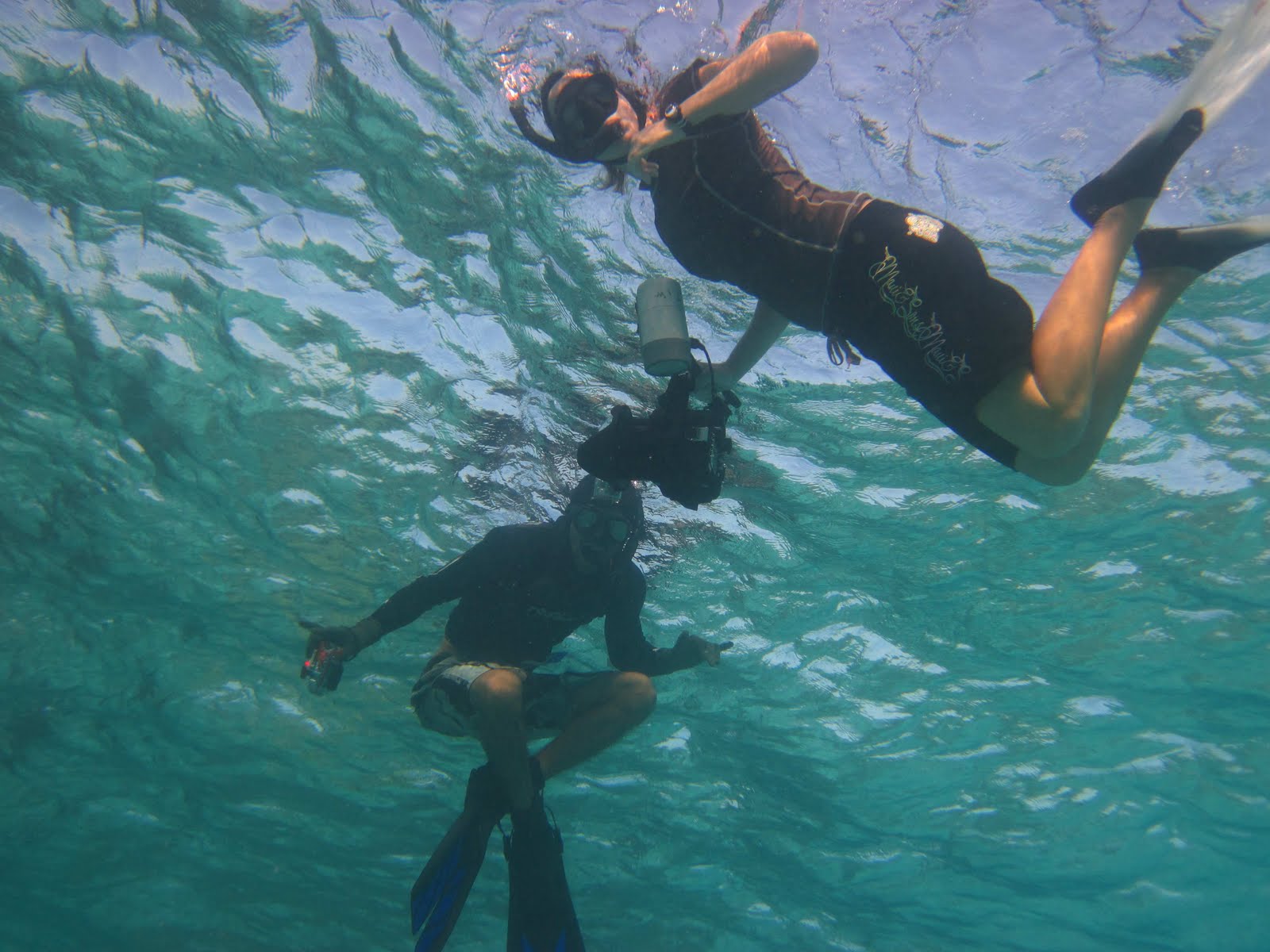
CORAL: FWS Volunteer Lindsey Kramer prodded us all out in the water at the crack of dawn, boating over to Shark Island (a couple miles from Tern Island) for early morning snorkels. She wanted to be the first person to witness cauliflower coral spawning in the Northwestern Hawaiian Islands. And guess what? It took a snorkeling a couple mornings in the frigid waters of April, and then a couple mornings in the warmer waters of May -- but she did it!!! We were able to be the very first witnesses of cauliflower coral spawning on May 18th, with more spawning occurring on May 19th. Way to go, Lindsey!!!
![]() |
| Photos by Paula L. Hartzell |
SEALS: We've had some gains and losses in the ʻilio o ke kai world... Some new pups, and some pups are gone. One nice event occurred when one of the seal crew, Ben Cook, was camping out on Gin Island last week. (The seal crew guys take turns staying out on the islands to watch out for the pups.) A first time seal mom give birth – and then as the mom and pup failed to bond. The pup wandered off looking for the mom, who was fairly unresponsive. The pup then got caught and battered in the surf. Ben was able to rescue the pop, and reunite the pair for the first nursing, which is the critical bonding period for these seals. The new mom accepted the pup, and it looks like they’re doing well. The pup likely would have died without intervention, so we’re really glad Ben was out there.
OUTREACH: We have to send out a special thanks to our new Education and Outreach Coordinator, Barbara Mayer, who has been working on curriculum for teachers to use this Fall. An established curriculum and lesson plans will help teachers -- who are already overworked -- have an easier time working information on the Northwestern Hawaiian Islands and Kānemilohaʻi into their classrooms. That should be great fun for the kids! Barbara is also working with ʻIolani School for a Marine Debris class this summer -- so those of us on Tern are also busy collecting some marine debris, empty bird eggs, and the like to send back for the class. She's also the one responsible for making the blog more organized and functional. Mahalo nui e Barb!
TURTLES: We counted 412 basking turtles on East Island this week!!! This is fantastic -- and pretty amazing, considering the whole island is about 200 meters (650 feet) long!
![]() |
| Honu on East Island. We counted a remarkable 412 basking turtles at one time on East Island on Thursday this week. Photo by Paula L. Hartzell. |
BIRDS:
We completed our first estimate of the ʻewaʻewa (sooty terns) on Tern Island. There are about 133,000 adults and 32,500 eggs on island now -- That is one big bunch of ankle biters.
![]() |
| ʻEwaʻewa (sooty tern). Now multiply this by 133,000 on an island a half mile long by a quarter mile wide. Now imagine each and every one pecking your head and ankles. :-) Photo by Paula L. Hartzell. |
The last Tristram’s storm petrel fledged from artificial nest boxes this week! FWS Volunteer Sarah Youngren has documented a strong relationship in patterns in weight gain and loss immediately prior to fledging, allowing us to accurately identify when a chick is ready to fledge. We have made enormous strides in development of consistent, replicable, quantitative method for monitoring TRSP; we have vastly reduced the number of human-crushed burrows; and look forward to development of adult population monitoring next year, thanks to Sarah’s hard work over then last two years – and on into next year. Good work, Sarah!
BUILDING NEWS: FWS Volunteer has constructed a new shade-house on the back-porch, and is adding a roof to our front porch. The shade-house will be used to grow native plants, which is sorely needed to give a boost to the shrubs on Tern Island. Birds need the shrubs for nesting habitat, shade, and to consolidate soil around burrows. Thanks, Curt, for getting all this built!
TEAM TERN:
![]() |
| ʻĀ (red-footed booby) chick and its parent squash in for room on the nest. Photo by Sarah Youngren. |
| Photo by Paula L. Hartzell. |
![]() |
| Laughing kaʻupu. (Black-footed albatross.) The chicks have their adult feathers on their bodies now, and getting some pretty funny hairstyles up top. |
![]() |
| Brown booby contemplates a fine day off of East Island. Photo by Mark Sullivan. |
![]() |
| Lindsey Kramer (top) and Mark Sullivan (bottom) waiting for coral to spawn. |
Labels:
Albatross-Black-footed,
Booby-Brown,
Booby-Masked,
Booby-Red-footed,
coral,
education outreach,
Hawaiian Monk Seal,
ʻĀ makaʻele,
maintenance,
marine debris,
Storm-Petrel-Tristram’s,
Tern-Sooty,
Turtle-Hawaiian Green Sea
Subscribe to:
Posts (Atom)
Popular Posts
-
Aloha kakou! I have had so much fun, and learned so much at Tern Island Field Station over the past three years. I send sincere thanks to...
-
As I mentioned last night and this morning, we were very fortunate to have had no real effects from the tsunami on Tern. We have a nice big...
-
Aloha kākou! E komo mai o French Frigate Shoals and Tern Island. The staff and volunteers at Tern Island are in the midst of change – Stati...