Search This Blog

Showing posts with label ʻĀ makaʻele. Show all posts

Thursday, December 8, 2011

The Trip In

The new Tern crew loaded up -- along with SeeMore satellite technicians Konrad Schaad and Ralph Blancato, and Tern special volunteers Kathy Kawakami and Barbara Mayer -- on December 1st, for the three day trip out to French Frigate Shoals.
Women to Tern Island:  Morgan Gilmour, Sarah Youngren, Barbara Mayer, Dakshina Marlier, and Kathy Kawakami onboard the ship Kahana en route to French Frigate Shoals.
The first day at sea was pretty shaky, or at least most of the crew was. Things calmed down (both weatherwise and physically) after that, though. All of us enjoyed some great food onboard the ship Kahana, and some nice home-made music in the evening, courtesy of the Kahana's Nalu and our own volunteers.
A quiet moment as La Perouse comes into view. 
We arrived at Tern on Sunday, with a speedy offload due to good weather.   Come along on one of the small boat transfers from the good ship Kahana to the Island--


So much has changed since this summer!!!!  The crew on-island has built a tremendous amount of artificial habitat, experimenting with different materials and styles to see what the birds will accept for nesting.
Mōlī (above) and ka'upu nesting in runway.  Since some vegetation has returned to the runway, albatross are enjoying the extra room to nest.
The island is also green with winter.  As some vegetation starts to fill in the runway, both black-footed and Laysan albatross are moving nests into the green parts.  This will greatly expand their nesting area by about 30% -- a significant enlargement on one of two islands in the atoll that do not get washed over regularly.  The habitat is also important in that French Frigate Shoals is not as readily damaged by tsunami and storm waves as some other important seabird locations, such as Kure, Midway and Laysan, so provides an important refugia.
Albatross Love.  Photo by Ralph Blancato.
Manager Meg Duhr Schultz shows the crew around, and fills them in on all the rules.  We live happily on Tern Island -- but must always respect that this is the home of the wildlife first!
Manager Meg drills the troops (Dan Rapp, Dakshina Marlier, Barbara Mayer, and Abram Fleishman, L>R).
Meg leads the first entrapment walk -- All folks must participate in orientation when they arrive.  (Morgan Gilmour, Dakshina Marlier, Abram Fleishman, Meg Duhr Schultz)
Sarah Youngren and Abram Fleishman work on setting up acoustics equipment for monitoring seabirds at night.  Sarah is working with UCSC's Matthew McKown and Nexleaf in this first-ever deployment of this remote monitoring system totally-off-the-grid (as in no cell phone even).  This project is pretty exciting because if it works well, we can use it to monitor nocturnally active seabirds without tromping through their burrows.  It could also be used in remote places like Nihoa and other uninhabited islands, without people staying there.
Konrad Schaad repairing our satellite system....Yeesh!!!  We have him to thank for this blog being posted -- and for use of our turtle cam and email systems!
We also had our first off-island experience of the season, counting seabirds, seals and turtle while Konrad and Ralph worked on the turtle cam (East Island).  We were happy to see a whole lot of nesting albatross, as well as a lot of mostly healthy looking seals. 
First 'a maka'ele (masked booby) eggs of the season!!!  Photo by Sarah Youngren.
A juvenile 'iwa (great frigatebird) inspects Konrad's work at the top of a telephone pole.  Konrad is fixing the cameras used by sea turtle researcher George Balaz for monitoring East Island -- where roughly half of the entire species nests!  Konrad is a tall man:  check out how this young frigatebird's wingspan dwarfs him in perspective.  Photo by Ralph Blancato.
Silver bellied 'ilio o ke kai (Hawaiian monk seal) juvenile.  Photo by Paula Hartzell. 
We expect the Kahana to return from its trip up to Midway around December 13th.  We will have more bird and seal news coming all winter!

A mother-daughter team on Tern:  Kathy Kawakami and Erin Kawakami tackle native plant propagation on Tern Island.  We appreciate Kathy's experience and Erin's energy -- and the willingness of all our volunteers to give their time for wildlife conservation at this remote location.

Tuesday, August 2, 2011

'Iolani School, Turtle Diggings and the Oscar Elton Sette

A busy couple of weeks!

We had a GREAT time skyping with JoAnn Stepien's class at 'Iolani School on O'ahu --  Thanks to 'Iolani School teacher JoAnn Stepien and FWS Volunteer Barb Mayer, joined by NOAA E&O Coordinator Wes Byers.  Take a look at pictures Wes put onto his Papahānaumokuākea Marine National Monument Facebook page.  And a most special thanks to the students!!!  'Iolani School's Marine Debris Awareness class welcomed us for a visit last week.  The visit included map study, dissection of albatross boluses, skyping with Tern volunteer Erin Kawakami, looking at marine debris collected off a turtle entrapped at French Frigate Shoals, and other activities.  
JoAnn Stepien's Marine Debris Awareness class at 'Iolani School on O'ahu, pays attention while FWS Tern Volunteer Barbar Mayer leads discussion on Tern Island.  Barbara brought albatross boluses, bones and eggs, as well as marine debris from entrapments, for the class to experience these firsthand.
Students skyped live with FWS Volunteer Erin Kawakami on Tern Island.    Erin is from the Big Island, and has wanted to visit the Northwestern islands her whole life.  One of these kids could be a volunteer, or perhaps the manager, not too long from now!!!
Our next big news at Kānemilohaʻi:  808 Nesting Honu on East Island alone!!!!  This has been a record breaking year, with more nesting turtles than ever recorded before -- the next best year was 589 nesting turtles.  
Honu 808!!!  This was the last of the nesting turtles identified by the turtle techs this field season.  If you look REALLY closely, you can see the '808' on her carapace, with a ying-yang for the '0'.  She is basking on Tern Island in this photo; you can see some turtle eggs she inadvertently dug up in the sand.  We'll expect another big nesting season in three or four years, with lower counts in between.
Balance in all things:  Unfortunately, with so many turtles digging, they have also dug up a large portion of the shrubs along the south side of  Tern Island.  This will probably speed up erosion along the south side, as well as eliminate a good deal of shrub habitat, of which we have none to spare.  (Note the boobies refusing to give up this bush!)  If the decision is ever made to permanently decommission the runway at Tern Island, we will plant shrubs in that area, providing a significant gain in shrub habitat.  Until then, we'll try to encourage both natural and propagated beach naupaka across the island.
More turtle digging means fewer Tristram's storm petrel burrows.  Turtle nest-building has removed a significant portion of the Tristram storm petrel area on Tern Island this year, moving all the way up into our reproductive monitoring plots.  We've been moving the nest boxes back onto solid ground several times this year, but the turtles keep digging further and further back, digging up burrows and tossing nesting boxes aside.  Tristram's usually return to the same burrow to nest; we hope to keep the pairs that were nesting in this area by increasing the number of artificial nest boxes.  Burrowing birds have a difficult time without shrubs to consolidate the soil, and protect the burrows from crushing by albatross, turtles, and humans.
As the turtle nesting season winds down, the turtle team wrapped up their field camp.  The whole gang pitched in to help them take down camp. They spent the next few days cleaning all the field gear, and packing it away for the next season.


The Amazing Summer Team at Tern gathers on the porch to show their muscle!  From top left to right:  Brendan Hurley,  Shawn Farry,  Ben Cook, Irene Nurzia Hamburg; second row:  Erin Kawakami, Scott Sturdivant, and Meg Duhr Shultz; bottom row:  Tyler Bogardus, Paula Hartzell, and Mark Sullivan.
The fall crew -- Scott Sturdivant, Erin Kawakami and Meg Duhr Schultz -- have started on their native plant propagation and planting projects, planning what they will be doing over the coming months.  So far they have created some additional catchment areas for fresh water for their plants, and outlined where they will be concentrating their efforts -- in addition to all of the regular bird monitoring they will be doing.  They've also been finding the first of the turtle hatchlings, and returning them to the sea.  (Some hatchlings get lost and confused in the vegetation.)  More from them in the coming months!


Above:  Erin Kawakami and Scott Sturdivant work on creating catchment for their native plant propagation projects. 
The summer crew splits up --  Erin, Meg and Scott (at right) get ready to say goodbye to Irene and Tyler (at left).  The crew arrived together in June.  While the turtle crew heads out until next year, the bird crew will stay on Tern until December.
Hugs goodbye.
One of the small boats off the NOAA Research Vessel Oscar Elton Sette arrives, bringing fuel for us to run our own boats.  Everything we use on Tern has to be delivered like this -- first on a large vessel from Honolulu, then on a tender from the ship to the island.  The Sette crew and scientists normally are performing marine research activities in the Monument; this time they are going up the Northwestern Island chain picking up the seal crews at the end of the field season.  The Sette will be back to Tern in a couple weeks to pick up our seal crew.  
Irene and Tyler leave with the NOAA Research Vessel Oscar Elton Sette crew.   They will ride up to Midway, and take a plane back to Honolulu.  Irene and Tyler worked some seriously long hours recording nesting sea turtles this year, and deserve such a great trip.  Thanks, crew!!!
So that's it for the news for now -- A hui hou, and see you next week! 

This week's gratuitous bird and sunset photos:
This is the life:  ʻĀ makaʻele (masked booby) chick relaxes on a coconut.  Masked boobies nest on open grounds, so do very well on all of the sandy islands in the atoll, as well as on Tern Island.  They have big fat wide feet, like people, for standing on the ground.
Gin Island spit.

Birds of Tern Island.
An ʻĀ wāwae (red-footed booby) chick.  This one has most of his feathers now -- although he retains his chick fuzz-hood.  Red-footed boobies nest in shrubs, and have red monkey-like hands (okay, feet really) which are agile and finger-like, for grasping branches.
La Perouse at sunset.

Wednesday, June 15, 2011

Fledging Albatross, Baby Seals, and Immersion Suits

"I'm flying!!!"  Well, almost.  The kaʻupu chicks have started to fledge this week -- We've seen several taking off from Tern and Trig Islands.  They'll continue fledging over the next month.  The mōlī (Laysan albatross) will start fledging in the next couple weeks as well.  These birds will spend the next several years at sea, not returning to land until they are ready to start learning how to be parents.  Most of these birds will return directly to Tern.  Its been very exciting watching them grow up!  Photo by Paula L. Hartzell.

Team Tern on East:  From left to right, Dan Rapp, Sarah Youngren, Kristina Dickson and James Macaulay banding black-footed albatross (ka'ula) chicks on East Island.  We are excited about banding on the outer islands of the atoll, because this information will help us better understand how these birds adapt to changes in island geomorphology, storm events and tsunamis.


An ʻilio o ke kai mom and pup move up on land to sleep for the night.  A healthy mom will stay with her pup throughout the nursing season, never leaving the pup to feed.  A fat mom is a good mom, because she births fatter pups and nurses them longer.  Attentive moms are also more successful at protecting their pups from sharks.  Photo, with La Perouse Pinnacle in the background, by NMFS crew Mark Sullivan.
View of Gin Island from Little Gin Island.  The NMFS crew has been camping on Gin for two weeks straight, in an attempt to monitor and protect pups on that island. Can you imagine staying on such a small low island overnight by yourself?!?  Photo by Paula Hartzell.
Lindsey Kramer and James Macaulay cheerfully pump gas into -- and back out of -- the Spam.  Sometimes you think you're going somewhere, sometimes not.... But they kept a smile on their faces regardless.  You never know what the conditions or challenges will be, so you have to be willing to roll with the punches...
Safety Training!!! The team practices with immersion suits... Kinda funny on a tropical island!!!  We need to know how to use the suits, though, if we have to evacuate via boat for long periods of time, or at night, when hypothermia is a real possibility.  Still, it was pretty funny to see the honu swimming up to check out the bright orange people....  Here the team practices making a raft with their bodies, for an ʻinjuredʻ person to rest on top, out of the water.  Practice makes perfect -- especially when you need to be able to rescue yourself, even when the situation is scary.  It is very important to be knowledgeable and practiced at emergency procedure when youʻre this far out at sea.

Sarah demonstrates relaxing in an immersion suit...a tricky proposition at best.  :-)  
Beauty and the Beast:  Fratricide in the MABO world.  Masked boobies, ʻA makaʻele, have two eggs as insurance in case they lose one.  If both eggs hatch, either the parent or the other chick will most often kick the weak one out of the nest to die (and hence why twins are rare).  Mark Sullivan caught this event on camera -- Nature is often incredibly beautify, and horribly harsh at the same time.
Dancing with Manta Rays.  Kristina Dickson and a manta ray enjoy underwater ballet.  Gorgeous photo by Sarah Youngren.
Me!
Happy seal pup.  Photo by Mark Sullivan.
"Give me your ankle!!!" [Sooty Tern, ʻEwaʻewa]

Sunday, May 29, 2011

A Busy Time at Kānemilohaʻi

Shew, the past couple weeks have been busy!!!

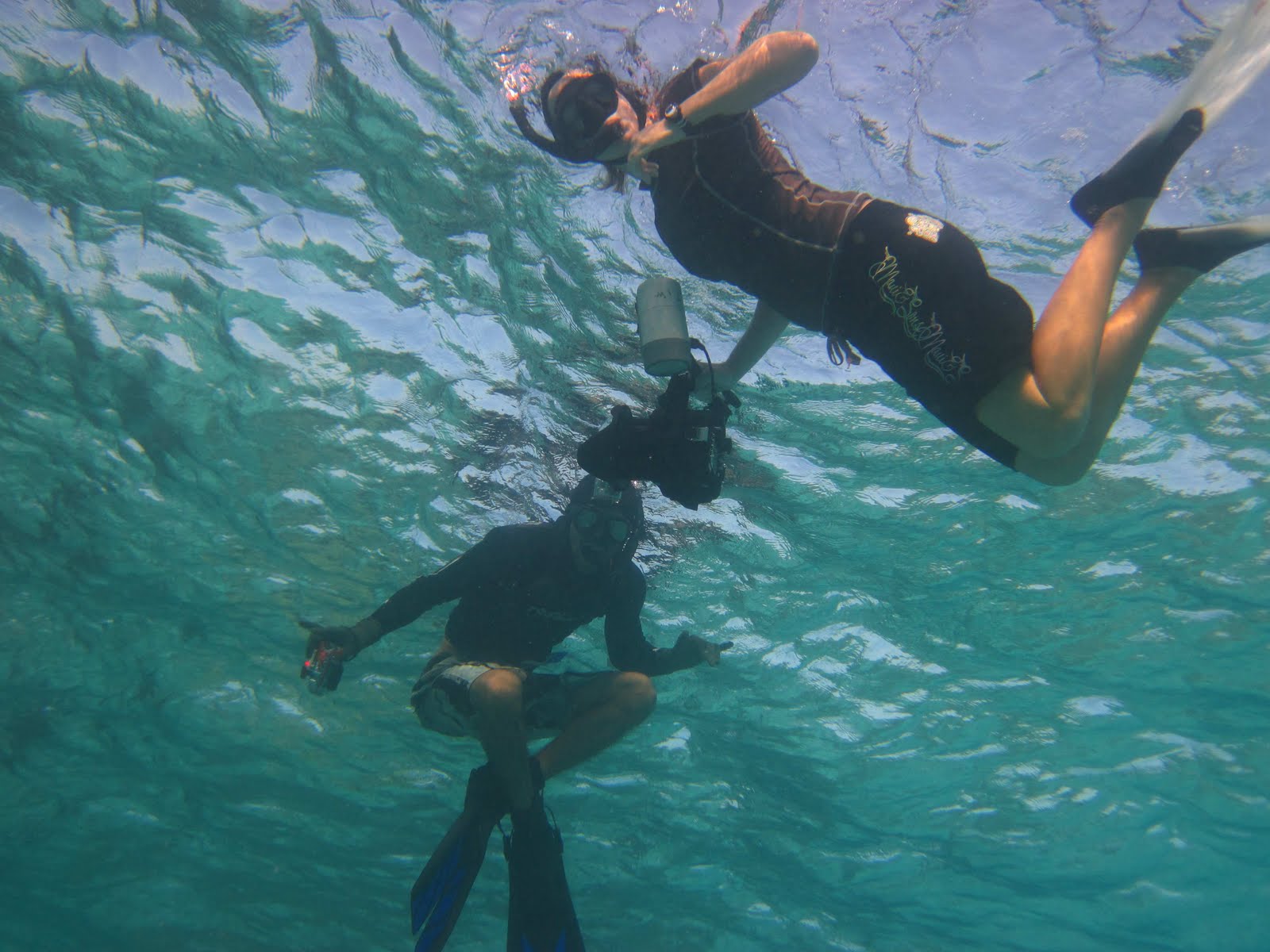
CORAL:  FWS Volunteer Lindsey Kramer prodded us all out in the water at the crack of dawn, boating over to Shark Island (a couple miles from Tern Island) for early morning snorkels.  She wanted to be the first person to witness cauliflower coral spawning in the Northwestern Hawaiian Islands.  And guess what?  It took a snorkeling a couple mornings in the frigid waters of April, and then a couple mornings in the warmer waters of May -- but she did it!!!  We were able to be the very first witnesses of cauliflower coral spawning on May 18th, with more spawning occurring on May 19th.  Way to go, Lindsey!!!


Photos by Paula L. Hartzell
SEALS:  We've had some gains and losses in the ʻilio o ke kai world...  Some new pups, and some pups are gone. One nice event occurred when one of the seal crew, Ben Cook, was camping out on Gin Island last week.  (The seal crew guys take turns staying out on the islands to watch out for the pups.)  A first time seal mom give birth – and then as the mom and pup failed to bond.  The pup wandered off looking for the mom, who was fairly unresponsive.  The pup then got caught and battered in the surf.  Ben was able to rescue the pop, and reunite the pair for the first nursing, which is the critical bonding period for these seals.  The new mom accepted the pup, and it looks like they’re doing well. The pup likely would have died without intervention, so we’re really glad Ben was out there.  

A new first-time mom (above) had problems bonding with her pup.  The pup got 'lost', when NMFS staff Ben Cook intervened, reuniting the pair.  The new mom accepted the pup, and it looks like they're doing well (below).  The pup would likely have died without the intervention, so we're really glad Ben was out there.   

Pups at Kānemilohaʻi face enormous challenges to make it through the first two years.  Insufficient forage for the moms mean less milk and shorter time to weaning for the pups.  The seal pups here are smaller as a consequence, even at birth: the biggest seal pup born here weighs less than the smallest pup born in the Main Hawaiian Islands -- Can you even imagine?!  They're also subject to high rates of shark predation over the past decade or so -- It may be that the sharks are also facing changes in forage, or perhaps they are attracted by the growing turtle population.  For whatever reason, we've already lost 4 of 10 pups so far, and its only the first month of the birthing season.  The seal team literally has to fight for the species one pup at a time!

OUTREACH:  We have to send out a special thanks to our new Education and Outreach Coordinator, Barbara Mayer, who has been working on curriculum for teachers to use this Fall.  An established curriculum and lesson plans will help teachers -- who are already overworked -- have an easier time working information on the Northwestern Hawaiian Islands and Kānemilohaʻi into their classrooms.  That should be great fun for the kids!  Barbara is also working with ʻIolani School for a Marine Debris class this summer -- so those of us on Tern are also busy collecting some marine debris, empty bird eggs, and the like to send back for the class.   She's also the one responsible for making the blog more organized and functional.  Mahalo nui e Barb!
This turtle had a ring of plastic -- waste from a boat -- caught around its neck.  The seal crew were able to catch the turtle, remove the ring, and release the turtle unharmed.  We saved the ring, which will be sent back to Honolulu on the next ship, for use in education and outreach.  Photo by Mark Sullivan.
TURTLES:  We counted 412 basking turtles on East Island this week!!!   This is fantastic -- and pretty amazing, considering the whole island is about 200 meters (650 feet) long!  

Honu on East Island.  We counted a remarkable 412 basking turtles at one time on East Island on Thursday this week.  Photo by Paula L. Hartzell.
Over 90% of the honu reproductive effort occurring at French Frigate Shoals.  The health of any species is dependent by many factors, and good management requires multi-faceted action.  The honu have benefited from very effective management in reducing fisheries-related mortality, some great luck (for the turtles anyway) in the increase in invasive algae species in Hawaiʻi, strong public support and wide emergency response in the Main Hawaiian Islands, along with the benefit of a totally protected nesting ground in the Monument – this threatened species’ population has been steadily increasing since 1973.  

BIRDS:  
We completed our first estimate of the ʻewaʻewa (sooty terns) on Tern Island.  There are about 133,000 adults and 32,500 eggs on island now -- That is one big bunch of ankle biters.

ʻEwaʻewa (sooty tern).   Now multiply this by 133,000 on an island a half mile long by a quarter mile wide.  Now imagine each and every one pecking your head and ankles.  :-)  Photo by Paula L. Hartzell.

How much effort do we spend monitoring birds on Tern Island?  We closely monitor about 1,500 individual nests each week!  That's in addition to all of the island-wide surveys, banding, entrapment walks, and special projects.

The last Tristram’s storm petrel fledged from artificial nest boxes this week!  FWS Volunteer Sarah Youngren has documented a strong relationship in patterns in weight gain and loss immediately prior to fledging, allowing us to accurately identify when a chick is ready to fledge.  We have made enormous strides in development of consistent, replicable, quantitative method for monitoring TRSP; we have vastly reduced the number of human-crushed burrows; and look forward to development of adult population monitoring next year, thanks to Sarah’s hard work over then last two years – and on into next year.  Good work, Sarah!


BUILDING NEWS:  FWS Volunteer has constructed a new shade-house on the back-porch, and is adding a roof to our front porch.  The shade-house will be used to grow native plants, which is sorely needed to give a boost to the shrubs on Tern Island.  Birds need the shrubs for nesting habitat, shade, and to consolidate soil around burrows.  Thanks, Curt, for getting all this built!


TEAM TERN:
While the bosses were away on the outer islands, the crew found a large rope mass floating in the water near the southeast end of Tern.  It took everyone working together to get it out.  (Apparently they all missed the memo that youʻre supposed to slack when the bosses are gone.)  From left to right:  Brendan Hurley (NMFS), James Macaulay (FWS), Kristina Dickson (FWS), Shawn Sullivan (NMFS), and Ben Cook (NMFS).  Photo by Sarah Youngren (FWS).
GRATUITOUS PRETTY (OR SILLY) PHOTOS
ʻĀ (red-footed booby) chick and its parent squash in for room on the nest.  Photo by Sarah Youngren.

Photo by Paula L. Hartzell.
Laughing kaʻupu.  (Black-footed albatross.)  The chicks have their  adult feathers on their bodies now, and getting some pretty funny hairstyles up top.  
Brown booby contemplates a fine day off of East Island.  Photo by Mark Sullivan.
Lindsey Kramer (top) and Mark Sullivan (bottom) waiting for coral to spawn.  
Sometimes you just have to step on your family..... An adult masked booby protects its chick.  Some might say masked boobies are a little overprotective -- A snowsuit in the tropics?!  Photo by Paula L. Hartzell.
THANKS to all of our readers, to the staff in Honolulu, and to our family and friends who support us.  We are very proud to be able to watch and protect these special resources, that belong to each and every one of us.

Popular Posts