Search This Blog

Showing posts with label Tern-Sooty. Show all posts

Monday, September 12, 2011

Deadly debris


This week we all got a good reminder that no piece of debris is too small to kill or injure wildlife. First we found this Sooty Tern fledgling stumbling around the colonies one evening. Because the poor creature was unable to fly, we captured it easily by hand and it became quickly evident why it was hobbling around. Its left leg was completely non-functional because a small section of monofilament fishing line had become tightly wrapped around the upper part of it. It had been there for quite some time because tissue had actually grown over the line.

Though this bird was still quite lively and, true to Sooty form, still attempted to bite and jab its handler, you can see from the condition of this bird's feathers that its chances of surviving this are not good. With feathers this far gone and its first molt not due for quite some time, our poor, (de)-feathered friend will not be able to leave the island and forage on its own. This is what will ultimately kill the bird. And while we cannot say for sure that the leg injury caused the feather degradation, its easy to imagine how weeks of hobbling around a seabird colony dragging wings through dirt and guano led to the present condition.

Anybody care to guess how long the offending piece of fishing line was?  Make an estimate, then check the answer at the bottom of this post!* 

These poor little Honu were recently found on the island as well. Since they turned up aways inland, the likely scenario is that they hatched out on the beach and somewhere between the ocean and middle of the island got tangled in this section of net. This particular piece of netting measured only 17" long and 3" wide. Typical commercial fishing gillnets like this can be up to several miles long. If a section this small can kill two turtle hatchlings imagine the damage that a mile of this stuff could do. It's an ugly thought.

We make every effort we can to remove the trash that washes ashore or gets blown inland, but even though Tern is a small island, there's still a lot of ground to cover by three people. We also have to carefully weigh the impact of our increased presence in active bird colonies and monk seal habitat with the benefit gained from removing debris immediately. There are no easy answers and we're still figuring out what our best approach should be. One thing is for absolute certain: it's important that the US Fish and Wildlife Service maintains its year-round presence out on Tern Island. If there were no staff and volunteers out here to collect debris and watch out for the turtles, seals, and seabirds that call this place home, there would be far more deadly entanglement incidents like this.

Shameless subject change! On a completely unrelated, but far brighter note, check out this Red-tailed Tropicbird chick. Born and raised right under our front porch, we get to enjoy watching her grow every day! Their eyes aren't actually quite that big, but they have a thick, black eye ring. So when a tropicbird chick looks at you straight on, their eyes look exaggeratedly large, cartoonish, and ridiculously adorable. Really, is it possible to not smile when you see this face???


(*Answer: 13 inches, which is an exponentially tiny fraction of the amount of derelict fishing gear and other debris that's out there in this bird's ocean habitat.)

Wednesday, September 7, 2011

A calm day on Tern

September 6, 2011: For the first time since I arrived to Tern almost 3 months ago, it is still. The Northeast tradewinds, normally a constant presence at the atoll, are almost entirely absent. Without even the slightest breeze, it's oddly quiet today. Not only do we not hear the sound of the wind moving between antennas and solar panels on the roof, but the sound of waves crashing against the shore south of the barracks is absent. The waters outside the lagoon are glass calm and a more subtle shade of blue than we usually see.

The birds have also quieted down substantially and it feels a little eerie out in the colonies. Everybody's laying low because it's HOT out there. Gular sacs are all aflutter (at least among the boobies and frigate birds), the sooty tern flocks are in disarray without a steady wind to orient themselves by, and everybody else has flocked, literally (bad pun fully intended), to any available shade.

With Tern Island's shrub habitat in decline and roughly 30% of the island taken up by a barren expanse of compacted gravel that does not support native plants (and therefore most of our bird species), shade is at quite a premium on Tern Island. Lucky for the birds, most of the chicks are past their most vulnerable stages in their lives when they lack the physical and behavioral adaptations to handle the heat. Here are a few examples of how Tern's seabirds coped with today's high temperatures.

Frigatebirds (ʻIwa) display perhaps the most diverse (and amusing) range of behavioral responses to heat. Here are just a few of them. There's the open wing posture (apparently this reduces water loss somehow). There's gular fluttering (intensity and duration of flutter typically correlates to how heat stressed a bird is), which really requires video footage for one to fully appreciate (stay posted on this one). And then there's what I've decided to call the 'I give up' posture. C'mon, it's not that hot, is it?


Scott has been steadily amassing a pretty sweet driftwood collection for his study plot in our Active Management Revegetation Zone between the runway and the colonies. Birds are attracted to the wood every day for the perching structure it provides, but today saw especially high interest in Scott's installations for the shade they provide.

When there's a steady wind (which is most of the time) all the sooty terns (ʻewaʻewa) in a flock like this will almost invariably be pointing straight into the wind. Seriously, on a windy day these birds are as effective as any windsock in indicating the wind direction. This is another behavioral response that helps them stay cool. I imagine it also keeps the feathers nice and smooth. You'll see from this photo, however, that on a dead calm day like today nobody quite knew where to stand! A minor detail, I know, but when you share a small island with thousands of seabirds, you notice things like this.

This little dome thing here is a recycled fuel barrel being used as a shade structure. We painted it white so it will reflect heat, drilled a few holes in the sides for cross-ventilation, and then anchored it to the ground. We're still in the early stages with these designs and if you look closely, you'll see a little gizmo on the ground that looks like a thumb drive. This is a temperature logger. We are currently measuring the inside temperature of our shade structures and comparing them to the temperatures under our natural shrub habitat. If these perform similarly, we'll make more and place them out in the colonies in time for the next breeding season.

Even a simple concrete block out on the runway surface makes a difference. We're still not quite sure how this tiny brown noddy (noio) chick made it way out there, but it looks like it's been reunited with its parents and managed to find a good spot to wait out the heat!


Wednesday, June 15, 2011

Fledging Albatross, Baby Seals, and Immersion Suits

"I'm flying!!!"  Well, almost.  The kaʻupu chicks have started to fledge this week -- We've seen several taking off from Tern and Trig Islands.  They'll continue fledging over the next month.  The mōlī (Laysan albatross) will start fledging in the next couple weeks as well.  These birds will spend the next several years at sea, not returning to land until they are ready to start learning how to be parents.  Most of these birds will return directly to Tern.  Its been very exciting watching them grow up!  Photo by Paula L. Hartzell.

Team Tern on East:  From left to right, Dan Rapp, Sarah Youngren, Kristina Dickson and James Macaulay banding black-footed albatross (ka'ula) chicks on East Island.  We are excited about banding on the outer islands of the atoll, because this information will help us better understand how these birds adapt to changes in island geomorphology, storm events and tsunamis.


An ʻilio o ke kai mom and pup move up on land to sleep for the night.  A healthy mom will stay with her pup throughout the nursing season, never leaving the pup to feed.  A fat mom is a good mom, because she births fatter pups and nurses them longer.  Attentive moms are also more successful at protecting their pups from sharks.  Photo, with La Perouse Pinnacle in the background, by NMFS crew Mark Sullivan.
View of Gin Island from Little Gin Island.  The NMFS crew has been camping on Gin for two weeks straight, in an attempt to monitor and protect pups on that island. Can you imagine staying on such a small low island overnight by yourself?!?  Photo by Paula Hartzell.
Lindsey Kramer and James Macaulay cheerfully pump gas into -- and back out of -- the Spam.  Sometimes you think you're going somewhere, sometimes not.... But they kept a smile on their faces regardless.  You never know what the conditions or challenges will be, so you have to be willing to roll with the punches...
Safety Training!!! The team practices with immersion suits... Kinda funny on a tropical island!!!  We need to know how to use the suits, though, if we have to evacuate via boat for long periods of time, or at night, when hypothermia is a real possibility.  Still, it was pretty funny to see the honu swimming up to check out the bright orange people....  Here the team practices making a raft with their bodies, for an ʻinjuredʻ person to rest on top, out of the water.  Practice makes perfect -- especially when you need to be able to rescue yourself, even when the situation is scary.  It is very important to be knowledgeable and practiced at emergency procedure when youʻre this far out at sea.

Sarah demonstrates relaxing in an immersion suit...a tricky proposition at best.  :-)  
Beauty and the Beast:  Fratricide in the MABO world.  Masked boobies, ʻA makaʻele, have two eggs as insurance in case they lose one.  If both eggs hatch, either the parent or the other chick will most often kick the weak one out of the nest to die (and hence why twins are rare).  Mark Sullivan caught this event on camera -- Nature is often incredibly beautify, and horribly harsh at the same time.
Dancing with Manta Rays.  Kristina Dickson and a manta ray enjoy underwater ballet.  Gorgeous photo by Sarah Youngren.
Me!
Happy seal pup.  Photo by Mark Sullivan.
"Give me your ankle!!!" [Sooty Tern, ʻEwaʻewa]

Sunday, May 29, 2011

A Busy Time at Kānemilohaʻi

Shew, the past couple weeks have been busy!!!

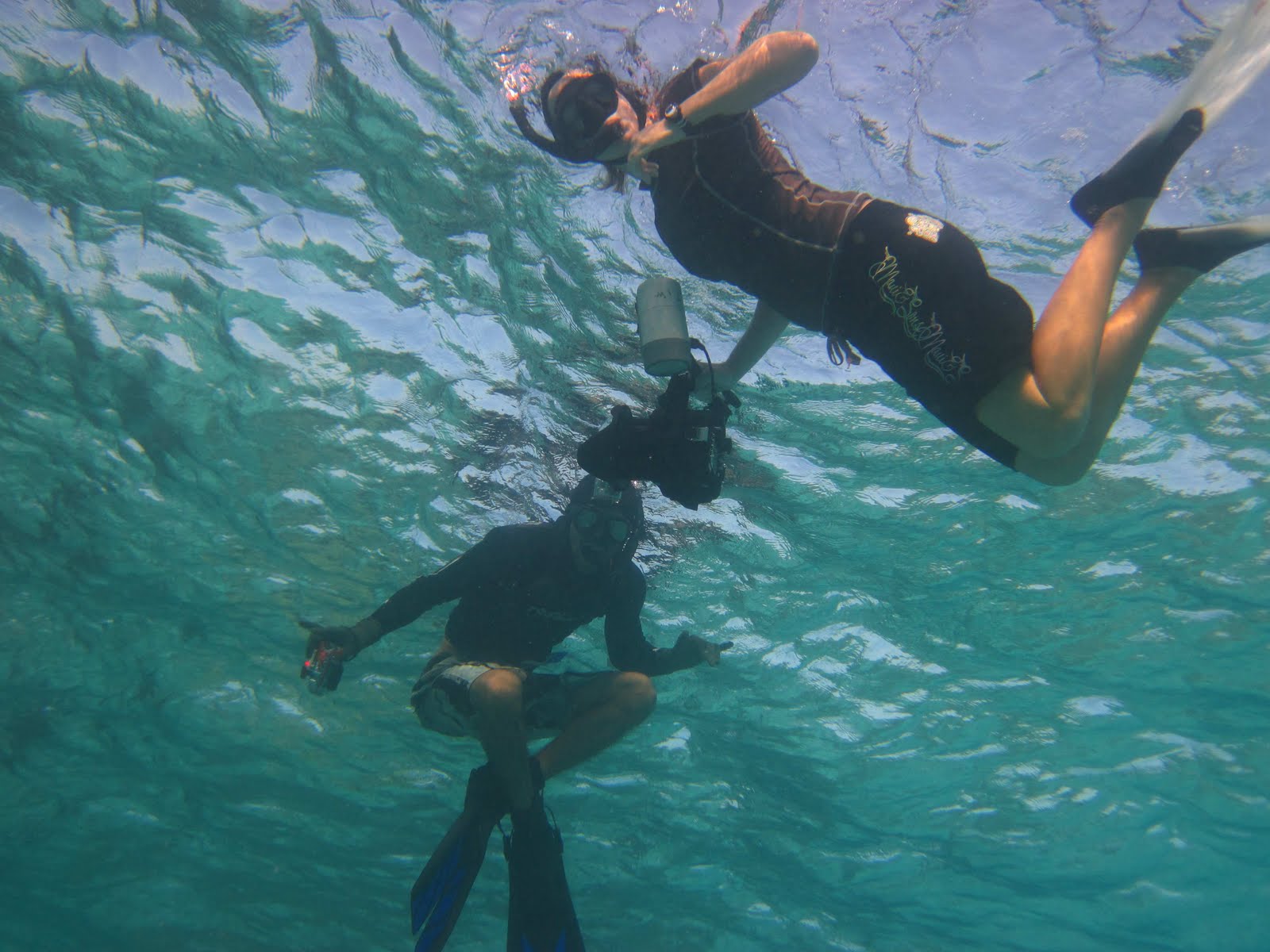
CORAL:  FWS Volunteer Lindsey Kramer prodded us all out in the water at the crack of dawn, boating over to Shark Island (a couple miles from Tern Island) for early morning snorkels.  She wanted to be the first person to witness cauliflower coral spawning in the Northwestern Hawaiian Islands.  And guess what?  It took a snorkeling a couple mornings in the frigid waters of April, and then a couple mornings in the warmer waters of May -- but she did it!!!  We were able to be the very first witnesses of cauliflower coral spawning on May 18th, with more spawning occurring on May 19th.  Way to go, Lindsey!!!


Photos by Paula L. Hartzell
SEALS:  We've had some gains and losses in the ʻilio o ke kai world...  Some new pups, and some pups are gone. One nice event occurred when one of the seal crew, Ben Cook, was camping out on Gin Island last week.  (The seal crew guys take turns staying out on the islands to watch out for the pups.)  A first time seal mom give birth – and then as the mom and pup failed to bond.  The pup wandered off looking for the mom, who was fairly unresponsive.  The pup then got caught and battered in the surf.  Ben was able to rescue the pop, and reunite the pair for the first nursing, which is the critical bonding period for these seals.  The new mom accepted the pup, and it looks like they’re doing well. The pup likely would have died without intervention, so we’re really glad Ben was out there.  

A new first-time mom (above) had problems bonding with her pup.  The pup got 'lost', when NMFS staff Ben Cook intervened, reuniting the pair.  The new mom accepted the pup, and it looks like they're doing well (below).  The pup would likely have died without the intervention, so we're really glad Ben was out there.   

Pups at Kānemilohaʻi face enormous challenges to make it through the first two years.  Insufficient forage for the moms mean less milk and shorter time to weaning for the pups.  The seal pups here are smaller as a consequence, even at birth: the biggest seal pup born here weighs less than the smallest pup born in the Main Hawaiian Islands -- Can you even imagine?!  They're also subject to high rates of shark predation over the past decade or so -- It may be that the sharks are also facing changes in forage, or perhaps they are attracted by the growing turtle population.  For whatever reason, we've already lost 4 of 10 pups so far, and its only the first month of the birthing season.  The seal team literally has to fight for the species one pup at a time!

OUTREACH:  We have to send out a special thanks to our new Education and Outreach Coordinator, Barbara Mayer, who has been working on curriculum for teachers to use this Fall.  An established curriculum and lesson plans will help teachers -- who are already overworked -- have an easier time working information on the Northwestern Hawaiian Islands and Kānemilohaʻi into their classrooms.  That should be great fun for the kids!  Barbara is also working with ʻIolani School for a Marine Debris class this summer -- so those of us on Tern are also busy collecting some marine debris, empty bird eggs, and the like to send back for the class.   She's also the one responsible for making the blog more organized and functional.  Mahalo nui e Barb!
This turtle had a ring of plastic -- waste from a boat -- caught around its neck.  The seal crew were able to catch the turtle, remove the ring, and release the turtle unharmed.  We saved the ring, which will be sent back to Honolulu on the next ship, for use in education and outreach.  Photo by Mark Sullivan.
TURTLES:  We counted 412 basking turtles on East Island this week!!!   This is fantastic -- and pretty amazing, considering the whole island is about 200 meters (650 feet) long!  

Honu on East Island.  We counted a remarkable 412 basking turtles at one time on East Island on Thursday this week.  Photo by Paula L. Hartzell.
Over 90% of the honu reproductive effort occurring at French Frigate Shoals.  The health of any species is dependent by many factors, and good management requires multi-faceted action.  The honu have benefited from very effective management in reducing fisheries-related mortality, some great luck (for the turtles anyway) in the increase in invasive algae species in Hawaiʻi, strong public support and wide emergency response in the Main Hawaiian Islands, along with the benefit of a totally protected nesting ground in the Monument – this threatened species’ population has been steadily increasing since 1973.  

BIRDS:  
We completed our first estimate of the ʻewaʻewa (sooty terns) on Tern Island.  There are about 133,000 adults and 32,500 eggs on island now -- That is one big bunch of ankle biters.

ʻEwaʻewa (sooty tern).   Now multiply this by 133,000 on an island a half mile long by a quarter mile wide.  Now imagine each and every one pecking your head and ankles.  :-)  Photo by Paula L. Hartzell.

How much effort do we spend monitoring birds on Tern Island?  We closely monitor about 1,500 individual nests each week!  That's in addition to all of the island-wide surveys, banding, entrapment walks, and special projects.

The last Tristram’s storm petrel fledged from artificial nest boxes this week!  FWS Volunteer Sarah Youngren has documented a strong relationship in patterns in weight gain and loss immediately prior to fledging, allowing us to accurately identify when a chick is ready to fledge.  We have made enormous strides in development of consistent, replicable, quantitative method for monitoring TRSP; we have vastly reduced the number of human-crushed burrows; and look forward to development of adult population monitoring next year, thanks to Sarah’s hard work over then last two years – and on into next year.  Good work, Sarah!


BUILDING NEWS:  FWS Volunteer has constructed a new shade-house on the back-porch, and is adding a roof to our front porch.  The shade-house will be used to grow native plants, which is sorely needed to give a boost to the shrubs on Tern Island.  Birds need the shrubs for nesting habitat, shade, and to consolidate soil around burrows.  Thanks, Curt, for getting all this built!


TEAM TERN:
While the bosses were away on the outer islands, the crew found a large rope mass floating in the water near the southeast end of Tern.  It took everyone working together to get it out.  (Apparently they all missed the memo that youʻre supposed to slack when the bosses are gone.)  From left to right:  Brendan Hurley (NMFS), James Macaulay (FWS), Kristina Dickson (FWS), Shawn Sullivan (NMFS), and Ben Cook (NMFS).  Photo by Sarah Youngren (FWS).
GRATUITOUS PRETTY (OR SILLY) PHOTOS
ʻĀ (red-footed booby) chick and its parent squash in for room on the nest.  Photo by Sarah Youngren.

Photo by Paula L. Hartzell.
Laughing kaʻupu.  (Black-footed albatross.)  The chicks have their  adult feathers on their bodies now, and getting some pretty funny hairstyles up top.  
Brown booby contemplates a fine day off of East Island.  Photo by Mark Sullivan.
Lindsey Kramer (top) and Mark Sullivan (bottom) waiting for coral to spawn.  
Sometimes you just have to step on your family..... An adult masked booby protects its chick.  Some might say masked boobies are a little overprotective -- A snowsuit in the tropics?!  Photo by Paula L. Hartzell.
THANKS to all of our readers, to the staff in Honolulu, and to our family and friends who support us.  We are very proud to be able to watch and protect these special resources, that belong to each and every one of us.

Saturday, May 14, 2011

Tiger Sharks, Seaturtles, and Birds


Aloha kakahiaka kākou!

This has been an exciting week at Tern Island!  (And please forgive all the formatting errors in this post -- Its giving me fits, but takes hours to upload.)

We witnessed four tiger sharks eating a sea turtle in the lagoon behind the barracks one morning this week.  We do not know if the turtle was alive or dead when it was attacked, but the sharks showed no interest at all in healthy turtles swimming by, nor in albatross sitting on the water nearby -- even "Bob," a turtle with no front fins at all was fine nearby -- so we're guessing the turtle was probably dead to start off with.   Although it may seem cruel on the sharks' part, they have to eat too.... That's their job.

Add caption
Add caption
Still, it was pretty exciting to see some big sharks so excited in the water nearby.  It was a bit of a relief to me see that the sharks really weren't interested in the live, healthy stuff -- and to know that they really must not be all that interested in us, or we would definitely be seeing more of them if they were.


Tiger sharks trying to break open a sea turtle carapace.  The turtle was probably dead when they found it (although we don't know for sure), as the sharks were completely uninterested in the live turtles swimming around -- One turtle swam by within 20m of the sharks milling around, fully within sight and smell, and the sharks were not the least bit interested.  They were definitely interested in the dead one, though!!!

The crew watched four tiger sharks (and a curious white-tipped reef shark) from the roof of the barracks.  We could have gotten better photos in the water, but strangely, no one offered to go diving that morning....  (The dark spot in the lower left is a turtle swimming by.  The four dark spots in the middle are the tiger sharks.)
Team Tern watches from the roof.  Its really nice to have compatriots to share these experiences with.  (And you can see all the hard work that Curt has gone to fixing our roof!!!)


Lindsey Kramer and Sarah Youngren team up to band a Black-footed Albatross chick.  A light cloth over the chick's eyes keeps it calmer.  The hearing protection is necessary because of the ʻewaʻewa (sooty terns).

Bird with an attitude.  ʻewaʻewa (sooty tern) are currently at about 2.5 birds per square meter on Tern -- very roughly about 115,000 ʻewaʻewa on island -- hence why hearing protection is needed.  Photo by Paula L. Hartzell.

 More on a turtle rescue....when the internet allows!

Monday, May 2, 2011

Seals and Birds

ʻIlio o ke kai (Hawaiian monk seal).  Photo taken by FWS Volunteer Kristina Dickson while snorkeling.

NMFS seal staff Shawn Farry pushes the boat off from a small outer island in the atoll.  Photo by Kristina Dickson.
FWS Volunteers band their 100th albatross chick today -- KZ00 (ʻCuzcoʻ)!  From left to right:  Kristina Dickson, Sarah Youngren, Lindsey Kramer, James Macaulay, and Dan Rapp.  Photo by Curt Youngren.

FWS volunteers gather about 750 lbs of marine debris from East Island.  Clockwise from left:  Dan Rapp, Paula Hartzell, Jimmy Macaulay, Kristina Dickson and Lindsey Kramer.  Photo by Sarah Youngren.

Kristina Dickson dives through the La Perouse cave.  Photo by Mark Sullivan.
Runway chick:  One of several chicks who have made their home in the runway.  We don't have flights in the summer because of so many sooty terns, or we'd have to move these guys out of the way.
cloud of sooty terns
Exercising around the sooty terns can be a bit of a challenge...as Curt Youngren demonstrates.

James Macaulay and Kristina Dickson band a red-tailed tropicbird.
Dan really DOES have birds on his brain.  Sarah shaves a bird in Dan Rapp's hair.  (Ah, social life on a remote island...)
NMFS staff Mark Sullivan prepares for tagging a seal -- Those are seal tags on the rim of his hat, while he prepares antiseptic and gloves.  Photo by Kristina Dickson.
Let's play the stick game!  This young ʻiwa would buzz me ceaselessly until I offered him my camera as sacrifice.  Photo by Paula Hartzell.
A love tern brings some edible affection for its chick.  Photo by Mark Sullivan.
Quiet time on Tern... Dan Rapp enjoys some moments of solitude during the daily entrapment walk around the island.  Photo by Sarah Youngren.

Popular Posts