A couple more videos for those of you who are Tristram's storm petrel fans.
Videos complements of Dan Rapp and our trail cam:
Tristram's storm petrel call to mate
Getting your head into your work: Digging Tristram's
Showing posts with label Storm-Petrel-Tristram’s. Show all posts
Showing posts with label Storm-Petrel-Tristram’s. Show all posts
Sunday, February 5, 2012


Monday, January 16, 2012
New Bird Videos and Sound Clips
Short but sweet this week: Dan Rapp, who is practicing recording at burrow entrances and artificial nest boxes with a night-vision trail cam, has shared some videos of nocturnal seabirds in front of artificial nest boxes on Tern Island. Nocturnal burrowing seabirds can be very difficult to monitor, so it is difficult to track if their populations are increasing, decreasing, stable, or gone. Night vision is one way we may be able to 'see' these animals without accidentally crushing burrows, sticking our arms or equipment into their burrows, or otherwise disturbing them. Few people will ever get to see these birds -- so this is pretty cool to see!
Tristram's storm petrels live only in the northwestern Hawaiian Islands and the Bonin Islands of Japan. These giggly little seabirds flutter and patter over the ocean when they feed. (If you watch the video, keep watching to the end -- the sound actually comes after the bird moves out of sight.)
Tristram's are actually quite large for storm petrels, which are usually the smallest of all the seabirds. Birdlife International lists Tristram's as 'near threatened'; because we really don't have a reliable population estimate by any stretch of the imagination, their conservation status is really unknown, but they certainly are not widespread nor numerous. They're active at night, and nest in burrows or artificial nest boxes. Over this last year, Sarah Youngren and Dan Rapp found that Tristram's chicks are among the hardest hit by plastic ingestion (along with the more well known Laysan albatross). Tern Island is the only place in the United States, and perhaps the world (we're not sure what's going on in the Bonin Islands right now), where Tristram's are actively monitored -- so its important that we do a good job with this species.
Bonin petrels also live only on only a few islands in the Pacific, with a largest portion in the northwestern Hawaiian Islands. They feed both when sitting on the water and by dipping for prey. Bonin petrels used to breed in the main Hawaiian Islands, but rats killed them off there. They were almost eradicated from both Midway and the Bonin Islands, but since rats have been elimiated there, the Bonins are coming back.
Like many of these seabirds, Bonin petrels can live to be pretty old: Last year, Dan Rapp and Sarah Youngren found the oldest recorded Bonin Petrel in the world living right here on Tern Island! That bird was banded 30 years ago on Whale-Skate Island -- an island about 3 miles southeast of Tern that no longer exists. Imagine a bird that is older than most of the people reading this blog..... Over 50% of the world's Bonin population still live in the U.S. Pacific islands, so knowing about this bird's status is very important to us.
Sarah Youngren has recorded the night sounds on tern Island, with support and equipment from Matthew McKown (UCSC) and Martin Lukac (Nexleaf Analystics). Like the night-vision camera, the acoustics recorders can share some sounds that very few people will ever hear -- like this Tristram's storm petrel and albatross from Tern.
Tristram's storm petrels live only in the northwestern Hawaiian Islands and the Bonin Islands of Japan. These giggly little seabirds flutter and patter over the ocean when they feed. (If you watch the video, keep watching to the end -- the sound actually comes after the bird moves out of sight.)
 |
| Dan Rapp checking on trail camera at Tern Island. |
Tristram's are actually quite large for storm petrels, which are usually the smallest of all the seabirds. Birdlife International lists Tristram's as 'near threatened'; because we really don't have a reliable population estimate by any stretch of the imagination, their conservation status is really unknown, but they certainly are not widespread nor numerous. They're active at night, and nest in burrows or artificial nest boxes. Over this last year, Sarah Youngren and Dan Rapp found that Tristram's chicks are among the hardest hit by plastic ingestion (along with the more well known Laysan albatross). Tern Island is the only place in the United States, and perhaps the world (we're not sure what's going on in the Bonin Islands right now), where Tristram's are actively monitored -- so its important that we do a good job with this species.
Bonin petrels also live only on only a few islands in the Pacific, with a largest portion in the northwestern Hawaiian Islands. They feed both when sitting on the water and by dipping for prey. Bonin petrels used to breed in the main Hawaiian Islands, but rats killed them off there. They were almost eradicated from both Midway and the Bonin Islands, but since rats have been elimiated there, the Bonins are coming back.
Like many of these seabirds, Bonin petrels can live to be pretty old: Last year, Dan Rapp and Sarah Youngren found the oldest recorded Bonin Petrel in the world living right here on Tern Island! That bird was banded 30 years ago on Whale-Skate Island -- an island about 3 miles southeast of Tern that no longer exists. Imagine a bird that is older than most of the people reading this blog..... Over 50% of the world's Bonin population still live in the U.S. Pacific islands, so knowing about this bird's status is very important to us.
 |
| Sarah Youngren setting up acoustics array. There's a microphone, cell phone (for relaying the signal to the computer & satellite dish), and other innards attached to the solar array, which powers the equipment. After calibrating this equipment, we may be able to use it in remote locations and sensitive locations such as Nihoa or Gardner Pinnacles, where people can't stick around to monitor seabirds. The acoustics allows us to obtain a relative number of seabirds active in an area -- and hence to follow trends in breeding populations. |
(I have to say, I can't stop laughing when I hear the Tristram's!)
Finally, some photos from this week... |
| Manu o Ku (white tern, love tern) on egg. How do they DO that?! |
 |
| Noio (black noddy) on egg. |
 |
| Ka'upu (black footed albatross) sky moo as part of their dance. Tern Island. Photo by Sarah Youngren. |
 |
| Northern sky on Tern Island. The land and birds were lit by moonlight. |
 |
| Tern Island Gothic. |
Tuesday, August 2, 2011
'Iolani School, Turtle Diggings and the Oscar Elton Sette
A busy couple of weeks!
We had a GREAT time skyping with JoAnn Stepien's class at 'Iolani School on O'ahu -- Thanks to 'Iolani School teacher JoAnn Stepien and FWS Volunteer Barb Mayer, joined by NOAA E&O Coordinator Wes Byers. Take a look at pictures Wes put onto his Papahānaumokuākea Marine National Monument Facebook page. And a most special thanks to the students!!! 'Iolani School's Marine Debris Awareness class welcomed us for a visit last week. The visit included map study, dissection of albatross boluses, skyping with Tern volunteer Erin Kawakami, looking at marine debris collected off a turtle entrapped at French Frigate Shoals, and other activities.
 |
| JoAnn Stepien's Marine Debris Awareness class at 'Iolani School on O'ahu, pays attention while FWS Tern Volunteer Barbar Mayer leads discussion on Tern Island. Barbara brought albatross boluses, bones and eggs, as well as marine debris from entrapments, for the class to experience these firsthand. |
 |
| Students skyped live with FWS Volunteer Erin Kawakami on Tern Island. Erin is from the Big Island, and has wanted to visit the Northwestern islands her whole life. One of these kids could be a volunteer, or perhaps the manager, not too long from now!!! |
 |
| Honu 808!!! This was the last of the nesting turtles identified by the turtle techs this field season. If you look REALLY closely, you can see the '808' on her carapace, with a ying-yang for the '0'. She is basking on Tern Island in this photo; you can see some turtle eggs she inadvertently dug up in the sand. We'll expect another big nesting season in three or four years, with lower counts in between. |
 |
| Balance in all things: Unfortunately, with so many turtles digging, they have also dug up a large portion of the shrubs along the south side of Tern Island. This will probably speed up erosion along the south side, as well as eliminate a good deal of shrub habitat, of which we have none to spare. (Note the boobies refusing to give up this bush!) If the decision is ever made to permanently decommission the runway at Tern Island, we will plant shrubs in that area, providing a significant gain in shrub habitat. Until then, we'll try to encourage both natural and propagated beach naupaka across the island. |
 |
| More turtle digging means fewer Tristram's storm petrel burrows. Turtle nest-building has removed a significant portion of the Tristram storm petrel area on Tern Island this year, moving all the way up into our reproductive monitoring plots. We've been moving the nest boxes back onto solid ground several times this year, but the turtles keep digging further and further back, digging up burrows and tossing nesting boxes aside. Tristram's usually return to the same burrow to nest; we hope to keep the pairs that were nesting in this area by increasing the number of artificial nest boxes. Burrowing birds have a difficult time without shrubs to consolidate the soil, and protect the burrows from crushing by albatross, turtles, and humans. |
 |
| The Amazing Summer Team at Tern gathers on the porch to show their muscle! From top left to right: Brendan Hurley, Shawn Farry, Ben Cook, Irene Nurzia Hamburg; second row: Erin Kawakami, Scott Sturdivant, and Meg Duhr Shultz; bottom row: Tyler Bogardus, Paula Hartzell, and Mark Sullivan. |
 |
| Above: Erin Kawakami and Scott Sturdivant work on creating catchment for their native plant propagation projects. |
 |
| The summer crew splits up -- Erin, Meg and Scott (at right) get ready to say goodbye to Irene and Tyler (at left). The crew arrived together in June. While the turtle crew heads out until next year, the bird crew will stay on Tern until December. |
 |
| Hugs goodbye. |
 |
| One of the small boats off the NOAA Research Vessel Oscar Elton Sette arrives, bringing fuel for us to run our own boats. Everything we use on Tern has to be delivered like this -- first on a large vessel from Honolulu, then on a tender from the ship to the island. The Sette crew and scientists normally are performing marine research activities in the Monument; this time they are going up the Northwestern Island chain picking up the seal crews at the end of the field season. The Sette will be back to Tern in a couple weeks to pick up our seal crew. |
 |
| Irene and Tyler leave with the NOAA Research Vessel Oscar Elton Sette crew. They will ride up to Midway, and take a plane back to Honolulu. Irene and Tyler worked some seriously long hours recording nesting sea turtles this year, and deserve such a great trip. Thanks, crew!!! |
So that's it for the news for now -- A hui hou, and see you next week!
This week's gratuitous bird and sunset photos:
 |
| This is the life: ʻĀ makaʻele (masked booby) chick relaxes on a coconut. Masked boobies nest on open grounds, so do very well on all of the sandy islands in the atoll, as well as on Tern Island. They have big fat wide feet, like people, for standing on the ground. |
 |
| Gin Island spit. |
 |
| Birds of Tern Island. |
 |
| An ʻĀ wāwae (red-footed booby) chick. This one has most of his feathers now -- although he retains his chick fuzz-hood. Red-footed boobies nest in shrubs, and have red monkey-like hands (okay, feet really) which are agile and finger-like, for grasping branches. |
 |
| La Perouse at sunset. |
Sunday, May 29, 2011
A Busy Time at Kānemilohaʻi
Shew, the past couple weeks have been busy!!!
CORAL: FWS Volunteer Lindsey Kramer prodded us all out in the water at the crack of dawn, boating over to Shark Island (a couple miles from Tern Island) for early morning snorkels. She wanted to be the first person to witness cauliflower coral spawning in the Northwestern Hawaiian Islands. And guess what? It took a snorkeling a couple mornings in the frigid waters of April, and then a couple mornings in the warmer waters of May -- but she did it!!! We were able to be the very first witnesses of cauliflower coral spawning on May 18th, with more spawning occurring on May 19th. Way to go, Lindsey!!!

 |
| Photos by Paula L. Hartzell |
SEALS: We've had some gains and losses in the ʻilio o ke kai world... Some new pups, and some pups are gone. One nice event occurred when one of the seal crew, Ben Cook, was camping out on Gin Island last week. (The seal crew guys take turns staying out on the islands to watch out for the pups.) A first time seal mom give birth – and then as the mom and pup failed to bond. The pup wandered off looking for the mom, who was fairly unresponsive. The pup then got caught and battered in the surf. Ben was able to rescue the pop, and reunite the pair for the first nursing, which is the critical bonding period for these seals. The new mom accepted the pup, and it looks like they’re doing well. The pup likely would have died without intervention, so we’re really glad Ben was out there.
 |
| A new first-time mom (above) had problems bonding with her pup. The pup got 'lost', when NMFS staff Ben Cook intervened, reuniting the pair. The new mom accepted the pup, and it looks like they're doing well (below). The pup would likely have died without the intervention, so we're really glad Ben was out there. |

 |
| Pups at Kānemilohaʻi face enormous challenges to make it through the first two years. Insufficient forage for the moms mean less milk and shorter time to weaning for the pups. The seal pups here are smaller as a consequence, even at birth: the biggest seal pup born here weighs less than the smallest pup born in the Main Hawaiian Islands -- Can you even imagine?! They're also subject to high rates of shark predation over the past decade or so -- It may be that the sharks are also facing changes in forage, or perhaps they are attracted by the growing turtle population. For whatever reason, we've already lost 4 of 10 pups so far, and its only the first month of the birthing season. The seal team literally has to fight for the species one pup at a time! |
OUTREACH: We have to send out a special thanks to our new Education and Outreach Coordinator, Barbara Mayer, who has been working on curriculum for teachers to use this Fall. An established curriculum and lesson plans will help teachers -- who are already overworked -- have an easier time working information on the Northwestern Hawaiian Islands and Kānemilohaʻi into their classrooms. That should be great fun for the kids! Barbara is also working with ʻIolani School for a Marine Debris class this summer -- so those of us on Tern are also busy collecting some marine debris, empty bird eggs, and the like to send back for the class. She's also the one responsible for making the blog more organized and functional. Mahalo nui e Barb!
 |
| This turtle had a ring of plastic -- waste from a boat -- caught around its neck. The seal crew were able to catch the turtle, remove the ring, and release the turtle unharmed. We saved the ring, which will be sent back to Honolulu on the next ship, for use in education and outreach. Photo by Mark Sullivan. |
TURTLES: We counted 412 basking turtles on East Island this week!!! This is fantastic -- and pretty amazing, considering the whole island is about 200 meters (650 feet) long!
 |
| Honu on East Island. We counted a remarkable 412 basking turtles at one time on East Island on Thursday this week. Photo by Paula L. Hartzell. |
BIRDS:
We completed our first estimate of the ʻewaʻewa (sooty terns) on Tern Island. There are about 133,000 adults and 32,500 eggs on island now -- That is one big bunch of ankle biters.
 |
| ʻEwaʻewa (sooty tern). Now multiply this by 133,000 on an island a half mile long by a quarter mile wide. Now imagine each and every one pecking your head and ankles. :-) Photo by Paula L. Hartzell. |
The last Tristram’s storm petrel fledged from artificial nest boxes this week! FWS Volunteer Sarah Youngren has documented a strong relationship in patterns in weight gain and loss immediately prior to fledging, allowing us to accurately identify when a chick is ready to fledge. We have made enormous strides in development of consistent, replicable, quantitative method for monitoring TRSP; we have vastly reduced the number of human-crushed burrows; and look forward to development of adult population monitoring next year, thanks to Sarah’s hard work over then last two years – and on into next year. Good work, Sarah!
BUILDING NEWS: FWS Volunteer has constructed a new shade-house on the back-porch, and is adding a roof to our front porch. The shade-house will be used to grow native plants, which is sorely needed to give a boost to the shrubs on Tern Island. Birds need the shrubs for nesting habitat, shade, and to consolidate soil around burrows. Thanks, Curt, for getting all this built!

TEAM TERN:
 |
| While the bosses were away on the outer islands, the crew found a large rope mass floating in the water near the southeast end of Tern. It took everyone working together to get it out. (Apparently they all missed the memo that youʻre supposed to slack when the bosses are gone.) From left to right: Brendan Hurley (NMFS), James Macaulay (FWS), Kristina Dickson (FWS), Shawn Sullivan (NMFS), and Ben Cook (NMFS). Photo by Sarah Youngren (FWS). |
 |
| ʻĀ (red-footed booby) chick and its parent squash in for room on the nest. Photo by Sarah Youngren. |
 |
| Photo by Paula L. Hartzell. |
 |
| Laughing kaʻupu. (Black-footed albatross.) The chicks have their adult feathers on their bodies now, and getting some pretty funny hairstyles up top. |
 |
| Brown booby contemplates a fine day off of East Island. Photo by Mark Sullivan. |
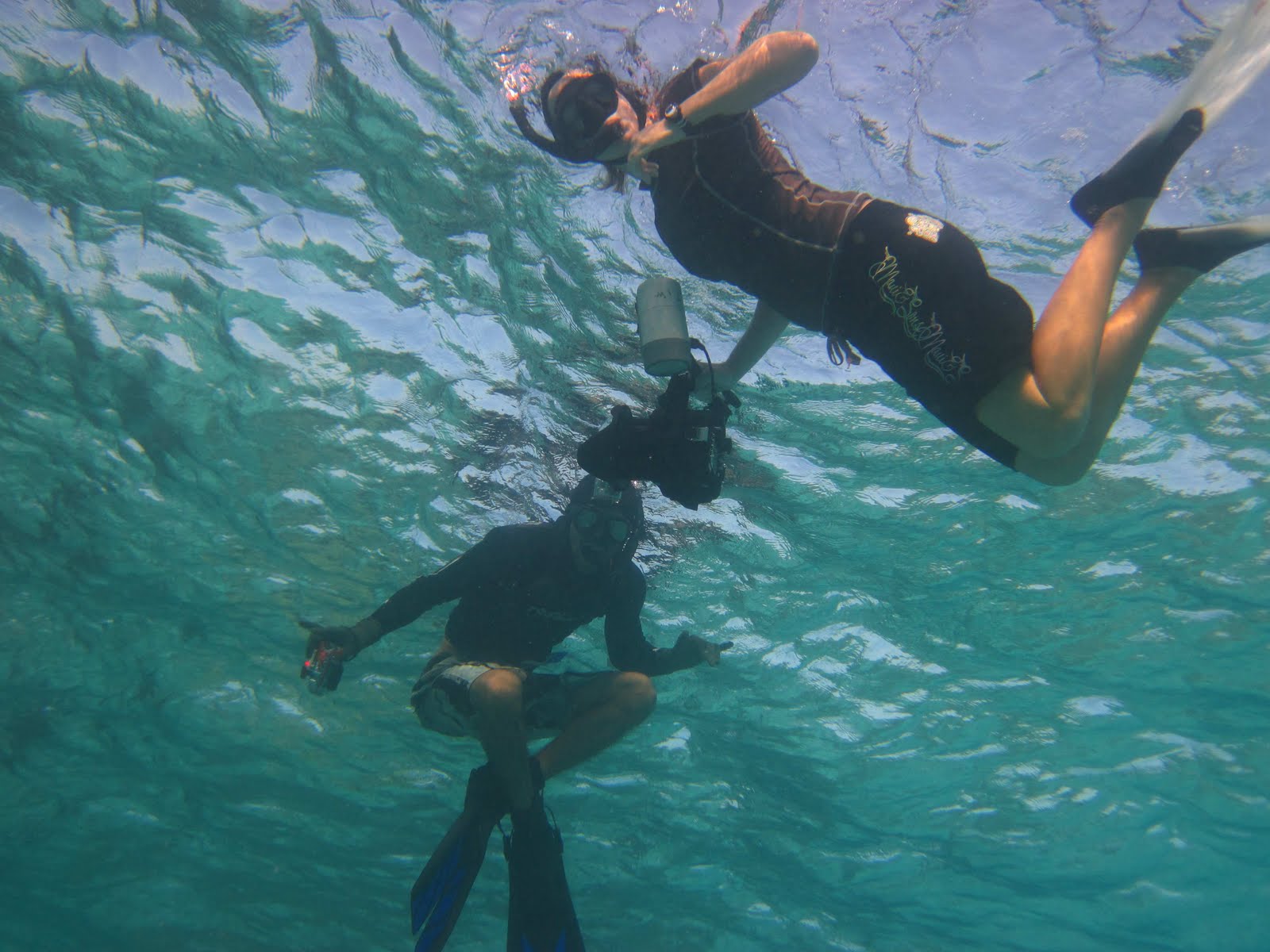 |
| Lindsey Kramer (top) and Mark Sullivan (bottom) waiting for coral to spawn. |
 |
| Sometimes you just have to step on your family..... An adult masked booby protects its chick. Some might say masked boobies are a little overprotective -- A snowsuit in the tropics?! Photo by Paula L. Hartzell. |
Tuesday, April 12, 2011
April 2011 at Tern Island

Aloha kākou, e komo mai o Kanemilohaʻi!
Its already April (however that happened) and life continues on here at Tern Island, as it does elsewhere. Our big news is the arrival of the NMFS seal crew, including Shawn Farry, Mark ("Sissy") Sullivan, Brendan Hurley and Ben Cook. The seal crew will be monitoring Hawaiian monk seals here at the atoll, as part of a larger effort to monitor and assist this critically endangered species.
 | ||
| The NMFS seal team translocates a newly weaned ʻīlio holo i ka uaua (Hawaiian monk seal) from an outer French Frigate Shoals island to Tern Island. Seal pups are frequently fatally bitten by sharks on some of the islands (4 of 8 were bitten on this island last year), while they are fairly safe from shark predation on Tern, where we have had no shark-bitten pups. Protecting the seal pups from shark predation is necessary because the population is so low now that every pup counts. NMFS seal crew members (left to right) Ben Cook, Shawn Farry, Brendan Hurley, and FWS Volunteer Lindsey Kramer. Photo by Mark Sullivan. |
 | ||
| Proud ʻā makaʻele (masked booby) parents watch over their chick. The MABO chicks are growing -- We look forward to their goofy 'snow man' suit as they get bigger. This is one of the few species we can tell males from females easily; the males hiss and the females honk. Photo by Lindsey Kramer. |
We continue trying to improve our monitoring and management efforts for the wildlife at Tern. The artificial shade shelters we have put up are being used by koaʻe ula (red-tailed tropicbirds), uaʻu kani (wedge-tailed shearwaters), pākalakala (gray-backed terns), and the albatross chicks (mōlī and kaʻupu). We've been monitoring temperatures in different vegetation types, and the effect on nesting success in albatross; now we're also monitoring temperatures in different artificial nest boxes, trying to find the best design to emulate the fairly constant temperature found in burrows.
 |
| A bigger hat for the house: Seabirds that nest in burrows have experienced high mortality due to invasive ant species, the burgeoning uaʻu kani population (they kick other species out of their burrows), and people accidentally crushing burrows while walking. One way we try to minimize these negative effects is to provide some artificial nest boxes that ʻseemʻ like burrows, with a small dark entrance, like the one shown here. Tristram's storm petrels -- which breed only in the Northwestern Hawaiian Islands and a few islands in Japan -- are a small burrow-nesting seabird that has been eliminated off many islands where they used to be, due to the introduction of rats and mice. (Their close cousins, the ʻakēʻakē or band-rumped storm petrel, live on Kauaʻi, and are having a real struggle to survive.) Tristram's have a higher nesting success rate in these artificial boxes which provide at least partial protection from ants and large people-feet, although the birds prefer to use burrows. We are always looking for ways to improve the boxes, to better emulate their natural environment, while protecting them from invasive species. FWS Volunteer Sarah Youngren has found that a larger shade top on nesting boxes lowers the maximum daily temperature experienced by the chicks inside, and so are likely to help increase chick survival in the boxes. We're trying out a number of designs, but have to do so slowly and carefully, so as not to disturb the birds. Photo by Sarah Youngren. |
 |
| Honu (Hawaiian green sea turtle) resting on the beach. Other green sea turtle species don't bask in the sun like this -- Must be a Hawaiian tradition! :-) Photo by Paula L. Hartzell |
 |
| Team Tern Spring 2011: Bottom row, left to right: Sarah Youngren, Curt Youngren, Paula Hartzell. Second row: Brendan Hurley, Kristina Dickson, Jimmy Macaulay. Third row, sitting: Ben Cook, Lindsey Kramer, Mark Sullivan. Standing: Shawn Farry and Dan Rapp. [Because Google's Blogspot, the software program being used in this blog, has a 200-character limit for the list of labels in a post, we were not able to include Hawaiian wildlife names in this post's labels. E kala mai, sorry!] |
Subscribe to:
Posts (Atom)
Popular Posts
-
Aloha kakou! I have had so much fun, and learned so much at Tern Island Field Station over the past three years. I send sincere thanks to...
-
 As I mentioned last night and this morning, we were very fortunate to have had no real effects from the tsunami on Tern. We have a nice big...
 -
 Aloha kākou! E komo mai o French Frigate Shoals and Tern Island. The staff and volunteers at Tern Island are in the midst of change – Stati...